A Republic That Forgot How to Behave
Every week, another headline breaks. A grand jury declines to indict a high official. Another official is investigated for digging through private records. Old torture reports resurface. Scandals pile up like sediment, but none of it feels surprising anymore.
The stories change. The pattern does not.
The real shock is not in the news itself. It is in the replies.
Every comment thread splits the same way. One side celebrates while the other deflects. The talking points are older than most of the people using them. People cheer for punishment as long as the target is someone they already disliked, then go silent when the same wrongdoing appears on their own side. Corruption is treated as evidence of evil in the opponent and evidence of complexity in the ally.
What used to be citizenship has become a kind of fandom.
A republic cannot survive this kind of selective morality. Not for long. Institutions can absorb scandal and even endure incompetence. What they cannot survive is a population that only believes in the rule of law when the outcome flatters their tribe.
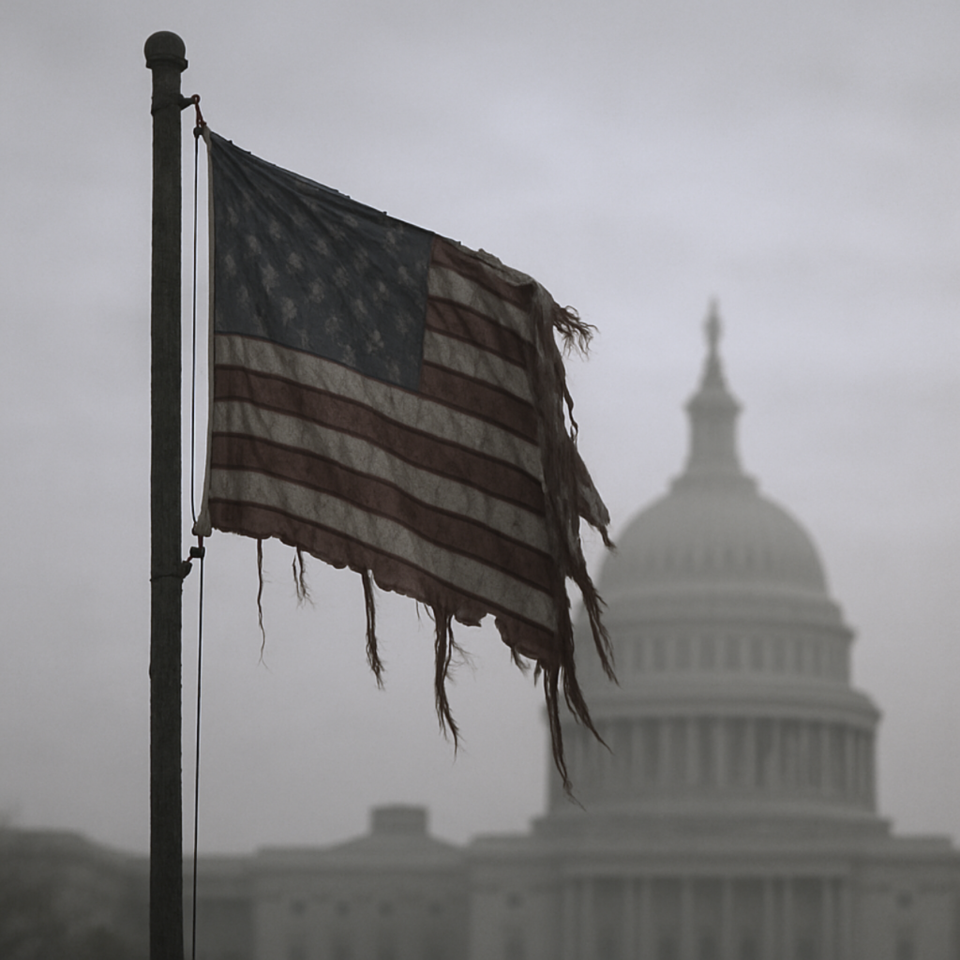
When justice becomes a scoreboard, the republic becomes ornamental. A flag, not a framework. A memory of something that worked better than what we have now.
This is why the quiet conversation happening across the country sounds the same from left to right: the sense that the American republic is no longer functioning in any recognizable way. Not fully broken or collapsed, just hollowed out.
There is a popular fantasy about how great powers fall. People imagine dramatic battles and sudden collapse. Reality is different. Nations rarely implode. They simply downgrade.
Consider Britain. When Egypt nationalized the Suez Canal in 1956, Britain tried to respond as empires do, with force and expectation of compliance. The United States stepped in and told them to stand down. They did. That was the moment. Not the end of British power, but the revelation that British power no longer mattered in the old way.
The currency still functioned and the government still operated. The flag still meant something. But the decisions that shaped the world were being made elsewhere, in Washington, in Moscow, and eventually in Brussels and Beijing. A superpower became an ordinary power, then a secondary one. Quietly and gradually, without the dignity of a clear ending.
The United States is drifting toward the same horizon.
A country that once set standards now debates its own basic functioning. A nation that once shaped global order now struggles to shape a budget. The Constitution has become a prop, the news a weapon, and the public square a stage where anger performs for an audience that mistakes performance for participation.
Great powers do not usually fall because another nation overwhelms them. They fall through distraction, mistaking outrage for principle, treating internal rivals as existential threats while viewing external rivals as distant abstractions. The population enjoys the adrenaline of conflict more than the discipline of governance.
This is how domestic dysfunction becomes geopolitical irrelevance.
Institutions that lose internal credibility lose external authority. Once treaties and commitments become negotiable based on which party holds power, other nations stop planning around American leadership. They plan around American absence.
If this pattern continues, the next hegemon will not have to invade, intimidate, or negotiate. It will simply wait. Patiently and quietly, while the United States burns its credibility for short-term victories inside comment threads.
Decline does not arrive as disaster. From the inside, it looks like entertainment, tribal celebration, a slow erosion of seriousness. People cheer each new scandal without noticing that every cheer brings them closer to a world where their cheers no longer matter.
A functioning republic requires shared norms, consistent standards, and a population that can tell the difference between justice and revenge. Without these, institutions still exist but lose their gravity. Elections still happen but lose their dignity. Power still shifts but nothing improves.
Not collapse but drift. The moment before consequences arrive, when a great power forgets how great powers behave.
The United States is not merely becoming a second-tier country. It is choosing this path one celebration at a time, never noticing the destination.