Diagnostic Staining and Biomarker Staining Are Not the Same Task
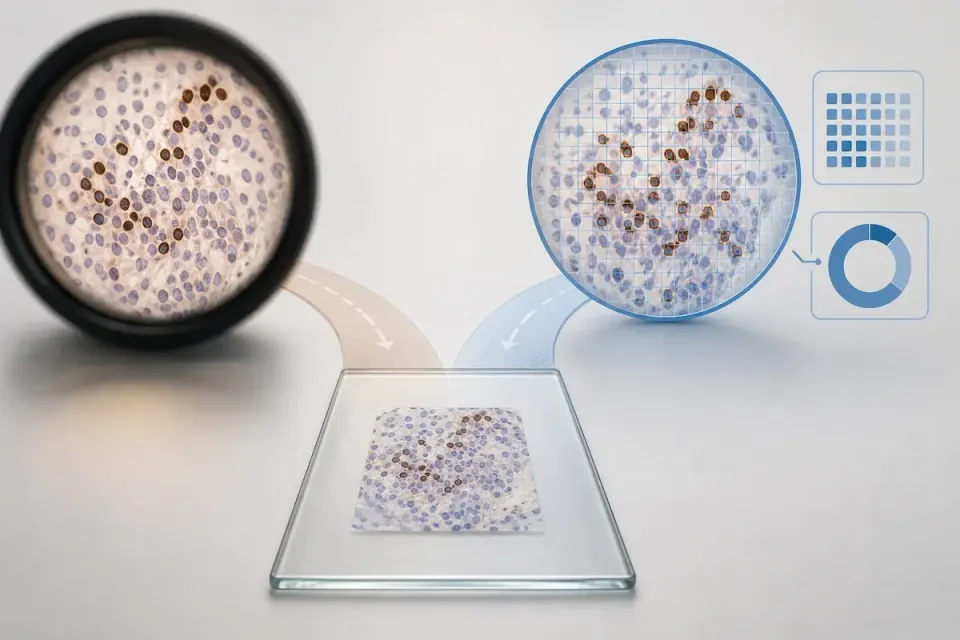
A finished IHC slide can look identical under two completely different sets of expectations. Same antibody, same platform, same run, and still one slide is a success while the other is a failure, depending on the question being asked of it.
The question itself rarely gets named. IHC tends to get discussed as one craft, measured against one idea of a good slide, even on benches that handle both kinds of work and feel the difference daily. The stain is not the deliverable. The answer is. And histology can ask a stain for one of two answers that are not interchangeable.
Two Questions, Not One
In clinical histology, the question usually runs:
Can the pathologist make a diagnosis?
In pharma biomarker work, the question usually runs:
Can this stain support a biological, pharmacodynamic, or patient-selection claim?
The two look related. They are not equivalent, and the gap between them is not cosmetic. It changes what "good enough" means, and it changes the entire control strategy that produces the slide in the first place.
Why the Diagnostic Question Tolerates More
A diagnostic stain feeds a human expert who integrates far more than the stain itself. The pathologist reads morphology, pattern, distribution, clinical history, and prior results alongside the chromogen. The stain is one input into a judgment rather than the judgment.
For that reason a diagnostic stain can absorb some variability and still do its job. When the diagnostic signal is obvious, meaning strong, well localized, and sitting in the expected compartment, minor drift in intensity or background rarely changes the call. The pathologist's expertise becomes the error-correction layer, and the system holds up because a person is reasoning over it.
The tolerance comes from a specific place. A human stands in the loop and can see through noise.
Why the Biomarker Question Tolerates Less
A biomarker stain often has no such person absorbing the noise. The output is frequently a number or a category: a percentage of positive cells, an H-score, a TPS or CPS, a HER2 level. That output drives an action. Does the drug engage its target? Did the marker move with treatment? Does this patient qualify for the therapy?
When the stain is the measurement, every source of variation turns into a source of misclassification. No expert quietly corrects for a weak run, because the weak run produces a different number, and the different number produces a different decision. Whatever correction the diagnostic world got for free now has to be engineered into the assay.
So biomarker staining demands tighter control over things diagnostic work can sometimes treat as secondary:
- Dynamic range. Real separation between low, intermediate, and high expression matters, because the cut-points live in that range. Compressed range collapses categories.
- Background. Nonspecific signal does more than look untidy. It inflates scores and pushes cases across thresholds.
- Reproducibility. The same tissue has to score the same way across runs, days, and operators, or the number means nothing.
- Scoring consistency. Readers, whether human or algorithmic, have to apply the same criteria the same way, which sits ahead of any analytic claim.
- Tissue comparability. Fixation, ischemia time, and section handling need enough control that you compare biology rather than pre-analytics.
- Control strategy. Controls stop being a formality. They are how you prove the assay ran in range that day and that the dynamic range was captured.
- Lot-to-lot performance. A new antibody lot that shifts intensity can quietly move a cohort across a cut-point.
- Platform transferability. A stain expected to behave the same on a different instrument or site has to be shown equivalent rather than assumed equivalent.
None of this is invented lab by lab. These expectations trace back to the assay validation and companion-diagnostic frameworks that govern biomarker work, the discipline of demonstrating an assay is fit for its intended purpose rather than simply staining well. That discipline is what separates a biomarker assay from a diagnostic stain that happens to share the same antibody.
The pattern runs in one direction: most of these sit upstream of the slide. Drift in fixation, reagent lot, or platform surfaces downstream as a changed score and a changed claim. The interpretation problem takes shape long before anyone reads the slide.
Why This Distinction Matters
The payoff is practical. The two jobs stop blurring into one.
A lab that inherits a biomarker assay and runs it with a diagnostic mindset assumes a reader downstream will compensate for a soft run. In biomarker work that reader does not exist. The number lands in a pharmacodynamic readout or a patient-selection decision, and the tolerance that felt acceptable in diagnostic work becomes the origin of an irreproducible result.
The reverse carries its own cost. Applying full biomarker-grade control to every routine diagnostic stain spends expensive rigor on a question that never asked for it.
Running IHC is the common thread. What shifts underneath is the question the stain answers, and the control strategy that answer pulls along with it. Same chromogen on the slide, a different job behind it.