Ink and Code Part 2: The Morality of Tools
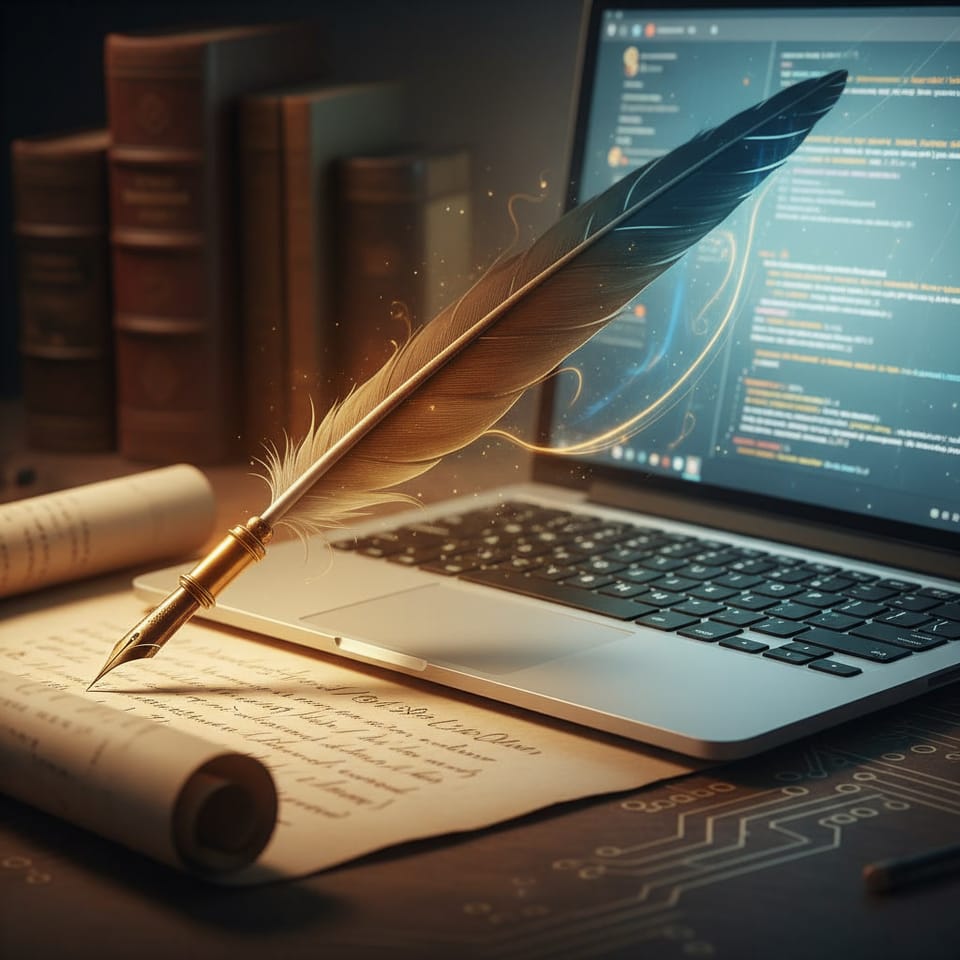
Every revolution begins with a tool. Every backlash begins with someone calling it impure.
When the camera appeared, painters called it theft. When the synthesizer arrived, musicians called it soulless. When the typewriter replaced the pen, editors said it dulled the writer’s intimacy with language. The word processor was called lazy. Digital art was called fake. Every generation meets its own invention with the same accusation: you didn’t earn it.
But art has never been about earning purity. It has always been about making meaning.
The Invention of Impurity
The morality of tools is not a moral truth. It is a social convenience. Each time a new medium emerges, those invested in the old one invent a story of moral decline. They frame the new as a betrayal of craftsmanship, as if creativity were a closed guild, reserved for those who have suffered for their materials.
It is a kind of gatekeeping masquerading as ethics. The critic claims to defend the spirit of art, but what they are really defending is a sense of order, a hierarchy that rewards the familiar.
The impulse is understandable. New tools threaten not just methods, but meanings. They unsettle the rituals that have come to define artistic worth. When we can no longer measure labor in sweat or time, we must find a new scale for value. And that is terrifying to those whose identity depends on being the measure itself.
So purity becomes a refuge. It offers certainty in the face of change. But purity is an illusion sustained by fear.
The Fear of Ease
Every accusation of impurity is, at heart, an accusation of ease. To say that a tool corrupts art is to suggest that it makes creation too easy, that it shortcuts the sanctified struggle.
But difficulty is not what gives art its meaning. Suffering may deepen an artist’s understanding of the world, but it does not guarantee insight. The assumption that value must be earned through hardship is a cultural inheritance from religion, not art.
Art is not a pilgrimage to worthiness. It is an act of perception. The camera does not cheapen vision; it extends it. The synthesizer does not erase emotion; it rearranges its tones. The algorithm does not steal imagination; it multiplies its expressions.
Ease is not the enemy of depth. It is often the condition that allows depth to emerge.
The Tool as Mirror
A tool is not moral. It is directional. It amplifies whatever hand holds it. The brush can paint a saint or a tyrant. The algorithm can generate emptiness or awe. The piano can score a requiem or propaganda. The outcome depends on the mind guiding it, not the mechanism beneath it.
Tools do not decide what is good. They only reveal what their users already are.
When we speak of “good” or “bad” tools, we are really speaking about our discomfort with seeing ourselves reflected back without disguise. The morality of tools becomes a proxy for the morality of the people who use them.
AI is no different. It is neither pure nor corrupt, benevolent nor deceitful. It is a mirror that magnifies human intention. And mirrors have always made us nervous.
The Exposure of Authorship
What unnerves the literary puritans is that AI exposes a truth too long ignored. It shows that authorship was never as solitary as we pretended. The boundaries between influence and originality were always porous. Every novel, poem, and essay is a collage of what came before: shaped, refracted, and remade through a particular mind.
The machine only makes this process visible. It does not invent imitation; it reveals that imitation is the grammar of creation itself.
For centuries, we have built our artistic myths on the fantasy of the individual genius. The painter alone in the garret. The poet communing with the divine. The novelist haunted by inspiration. These stories served us well. They made creativity seem sacred, something apart from the ordinary world. But they also made it exclusive, something reserved for the few.
Now that anyone can summon poetry from a line of code, the myth begins to crack. The hierarchy trembles, and those who sat highest upon it call the earthquake evil.
The Myth of Sacred Labor
We are told that to use AI in writing is to cheat, that real art requires struggle, that technology dilutes authenticity. But this argument rests on a confusion between process and purpose.
A violinist’s artistry is not measured by the difficulty of tuning strings, nor a photographer’s by the weight of their camera. What matters is the meaning produced, the emotional resonance achieved. The method may inform the art, but it does not define it.
The cult of sacred labor is one of the most enduring myths in creative culture. It tells us that suffering gives art moral weight. Yet history contradicts it at every turn. Some of the most moving works were created through joy, curiosity, even play. The creative act, at its purest, is not a test of endurance but a form of attention, the ability to see the world anew.
AI does not replace that attention. It redirects it.
The Human Signature
Every creative act leaves a signature, a trace of consciousness that no machine can simulate. It is the pattern of choice: what is emphasized, what is omitted, what tone is struck, what silence is left intact.
AI can predict structure, but it cannot care. It can generate rhythm, but it cannot mean. It can simulate empathy, but only because empathy has already been encoded by those who wrote it.
When a human writer works with AI, they are not surrendering their voice. They are sculpting it in a new material. The art remains human precisely because intention remains human.
To say that AI destroys authenticity is to misunderstand what authenticity is. It does not reside in the method of making. It resides in the sincerity of the maker.
The Inheritance of Creation
We like to imagine originality as invention ex nihilo, something born from nothing. In truth, creation has always been an act of inheritance. We inherit language, rhythm, metaphor, memory, form, and tone. We remix what culture has handed us, add our perception, and send it forward again.
AI is not an alien force intruding on that cycle. It is a tool that accelerates it. It gathers the residue of our collective imagination and hands it back in unexpected combinations. That may feel unnatural, but so did every revolution in expression.
When photography first appeared, critics said it would kill painting. Instead, it freed painters from realism. When film arrived, playwrights feared the death of theater. Instead, storytelling multiplied across dimensions. When digital music emerged, orchestras worried about extinction. Instead, genres expanded beyond recognition.
Each tool reshaped art not by erasing the old, but by revealing new possibilities within it.
The Invention of Fear
The moral panic surrounding AI art is not new. It follows a familiar script: the declaration of a boundary, the defense of purity, the prophecy of decline.
Behind each panic lies a simple anxiety, the fear of losing control over meaning. When the gate between creator and audience opens too widely, those who once guarded it feel endangered. Critics lose their monopoly on taste. Institutions lose their authority. The idea of the chosen few dissolves.
But art has never been sustained by authority. It thrives on disobedience, on the refusal to let definition calcify. Every movement that changed culture: impressionism, surrealism, hip-hop, digital film began as something dismissed as inauthentic.
To reject a new tool because it unsettles tradition is to forget that tradition itself was once a rebellion.
The Human Core
AI’s rise has reignited an ancient question: what makes art human? Some say it is emotion. Others say intention. Some believe it is the ability to suffer, others the capacity to wonder. But perhaps the simplest answer is this: humanity lies in relation.
Art is an act of connection, not possession. It exists in the space between the maker and the receiver, in the movement of meaning from one mind to another. That space remains untouched by the mechanics of creation.
Whether a sentence is handwritten or generated, the test is always the same: does it reach you? Does it move something within you that recognizes itself?
If it does, the tool becomes irrelevant.
The Exposure of the Self
The morality of tools endures because it hides a deeper truth — that our creative methods reveal us more than our creations do. We are drawn to purity because impurity exposes us. It shows how much of what we call originality is borrowed, how much of what we defend as individual is shared.
AI strips away the illusion of isolation. It makes visible the collective nature of thought. For some, that is liberation. For others, it feels like erasure. But both feelings stem from the same realization: creativity has never belonged to any one person.
We are conduits, not creators. The mind receives, rearranges, and releases. Every artist is a translator of influence. AI simply accelerates that translation.
What we fear is not that the machine will think, but that we will see how little of thinking was ever ours alone.
The Performance of Morality
The morality of tools is, in the end, a performance. It gives us the illusion of control, the comfort of righteousness. By moralizing technology, we avoid confronting the vulnerability of creation itself — that all making is uncertain, all inspiration partial, all meaning contingent.
To say that one method is purer than another is to pretend that art’s value can be measured by technique. But art’s power has never come from perfection. It comes from the trembling space where intention meets accident, where control gives way to discovery.
Every tool participates in that uncertainty. The brush trembles. The lens distorts. The algorithm surprises. The miracle of art is not that it resists imperfection, but that it transforms it into something beautiful.
The Continuum of Creation
There is no moral line separating the hand from the code. There is only a continuum of tools, each extending the reach of imagination in its own way. To declare one sacred and another profane is to misunderstand the history of art itself.
The chisel, the quill, the press, the camera, the circuit all are instruments of human curiosity. Each invention has widened the field of what can be expressed. To deny the next extension is to halt the conversation of creation.
Tools evolve. The questions remain.
The Final Measure
The true measure of art has never been how it was made, but what it awakens in those who encounter it. Whether it comes through pigment, pixels, or predictive text, its worth is judged by resonance, not process.
The task of the artist is not to preserve the purity of the medium, but to preserve the urgency of meaning. The only immorality in art is dishonesty — the refusal to see, to feel, to risk sincerity.
Every tool can serve that purpose. None can guarantee it.
Beyond the Instrument
Perhaps this is the lesson of every creative revolution: the tool changes faster than our faith in it. The moral panic always arrives before understanding. And yet, in time, each condemned instrument becomes invisible, absorbed into the ordinary machinery of making.
The pen was once suspect. The camera was once feared. The synthesizer was once mocked. Now they are simply tools, extensions of human expression.
AI will follow the same path. One day, it will no longer be called artificial. It will be recognized as another mirror in which human thought reflects itself.
What will remain constant is the question that outlives every medium: does it move us? Does it remind us of our shared strangeness, our fragile aliveness?
The morality of tools will fade. The responsibility of meaning will not.
— no-one
Thoughts you didn’t think, written for you anyway
Machines can mimic language, but meaning still belongs to us.
Stay to receive new essays on art, authorship, and the strange beauty of creation in the age of AI.