Neezer Skroob Chapter 3 - The Ghost of a Man
Carole of Ashes
In London's cold, where gaslights dim,
A ruined wretch, once known, now grim.
Five winters gone from Christmas cheer,
His fortune stolen, none drew near.
By the winter of 1849, Ebenezer Scrooge was scarcely recognizable as the man who had once strode the counting-house floor. He moved like a shadow through alleys and markets, his coat frayed to threads, his hair white with frost, his fingers wrapped in cloth that stank of rot. He was still alive, but he walked with the silence of the dead.
The city that had once feared his ledger now mocked his hunger. He sought shelter beneath bridges, where beggars huddled in straw. He warmed his hands at street fires, the flames fed by stolen wood and scraps of tar paper. Coal, once a commodity he bought by the ton, was now a single glowing cinder stolen from a careless grate.
He learned the economy of the poor. A farthing bought a heel of bread; a halfpenny, a mug of thin gin to warm the belly. For a penny, he might lie on a rope-bed in a doss house, strung shoulder-to-shoulder with men who coughed and cursed in the dark. More often, he slept in doorways, driven off by watchmen before dawn, his hat pulled low to keep the frost from his eyes.
In those nights, memories haunted him more than spirits. He thought of Tiny Tim, whose limp frame he had once carried upon his shoulder. But when he sought the Cratchit home, he found only cruel laughter spilling from its windows.
Tiny Tim was gone. The words came to him in fragments, overheard from a charwoman scrubbing the steps: the boy had died not six months past, coughing out his last in a room Scrooge's money had furnished. No one had thought to tell the man who had saved him once.
And in his place, the surviving children grew comfortable, then proud. All but the youngest, who still carried something of Tim's gentleness.
Once, hidden in the shadows, he heard Mrs. Cratchit's voice, sharp and unkind: "Best he's gone. A sickly child is no blessing, not when there are mouths to feed and fortunes to be kept." The words burned deeper than the cold.
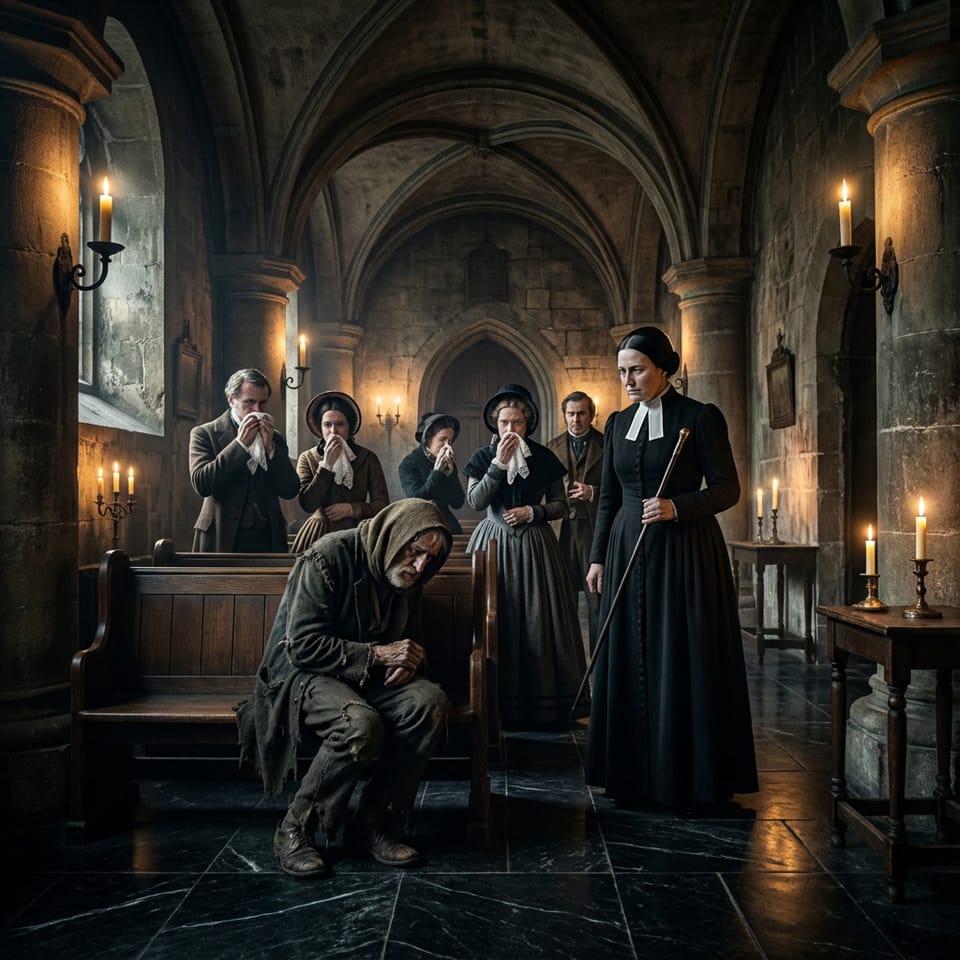
The churches, too, gave him no refuge. He tried to kneel among the poor in the pews of St. Mary Woolnoth, that heavy Hawksmoor church whose twin towers loomed over Lombard Street like watchmen carved in stone. Inside, the air was thick with the sour smoke of tallow candles, and the black marble floor reflected their flicker like pools of oil.
Scrooge bowed his head, hoping for warmth if not welcome, but parishioners shifted away, pressing lace handkerchiefs to their noses. Their whispers buzzed in the cavernous nave. A verger in his black gown tapped Scrooge sharply on the shoulder. "Sir," he said, his voice a hiss, "this house of God is not a refuge for the likes of you. Best you seek the workhouse."
The word cut deeper than any sermon. Once, he had threatened the poor with those very institutions. Now the church itself turned him toward them, as though salvation had no seat for the destitute.
Later, in Cheapside, the insult grew louder. The great street pulsed with life: fishmongers crying their wares, drapers calling from their stalls, the rattle of carts, the clatter of horses' hooves on cobbles. Gaslamps flickered in the fog, smearing their glow across wet stones.
Scrooge, hunched in rags, drifted past a tavern where laughter spilled into the street. A drunkard lurched forward, peering at him through bleary eyes. "Look there!" the man shouted, his words thick with gin. "That's old Scrooge, ain't it? Thought he was rich once!"
Others turned: hawkers, apprentices, a child perched on a cart. Their laughter joined his. "Ghost of his own self!" the drunkard crowed.
The name clung to him like frost: ghost. And so, in Cheapside's clamor, amid the cries of trade and the stink of smoke and horses, Ebenezer Scrooge was buried without coffin or grave, mocked into nothingness by the very city his ledgers had once commanded.
Thus, Scrooge, in life, became the very thing he had once feared in death: a forgotten spirit wandering the earth, chained not by Marley's iron but by poverty's silence.
And yet, in that silence, when no hearth welcomed him and no church claimed him, other voices began to stir. Not the voices of men, nor of God. Something older. Something waiting.