Neezer Skroob Chapter 4 - The Black Book
Carole of Ash and Blood
Yet in the soot, a book was found,
Its pages whispered underground.
With ink of ash and blood for vow,
He learned the rites the dead avow.
The winter broke men that year. London wore a mask of frost, but beneath it, hunger gnawed at the poor and the forgotten. Ebenezer Scrooge was one among many shadows, but unlike the rest, he carried not only cold in his bones but betrayal in his heart.
Days blurred into nights, and nights into a single long season. He scavenged crusts of bread, slept against brick walls, wrapped himself in tatters that once had been fine cloth. His mind circled endlessly around the same refrain: They made me weak. They unmade me.
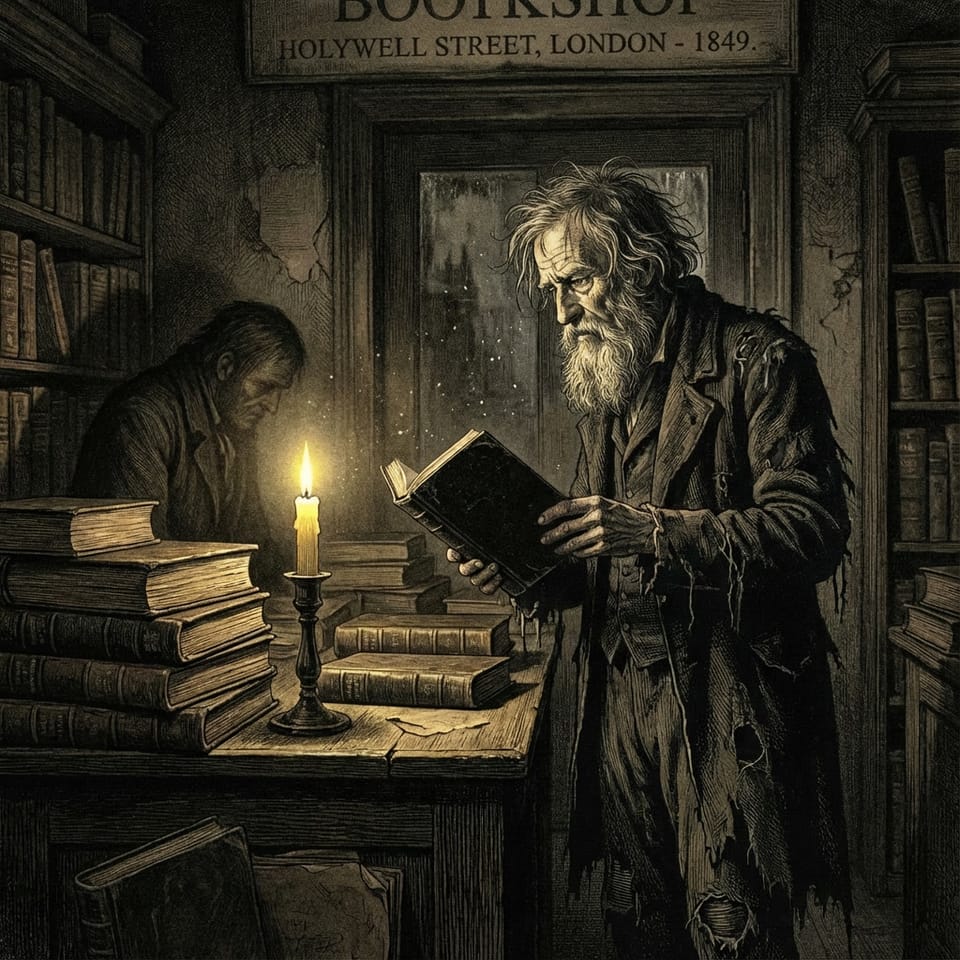
On a night when the fog hung low and thick, he wandered through the crooked passage of Holywell Street, that infamous stretch off the Strand where the stalls leaned close together and the air stank of damp paper. The place was notorious in London: a market for cheap novels, scandalous tracts, penny dreadfuls, and books a gentleman would not admit to owning. Even the gaslamps there seemed reluctant, their flames smudged in fog.
Most stalls had closed, shutters drawn tight against the cold. But one remained lit, a dim flame flickering behind warped glass. The sign above it was nearly illegible, the letters warped by time and soot.
Inside, the shelves leaned like drunks at a tavern, books stacked in tottering piles, paper curling with damp. A man sat behind the counter, or rather, a figure, his form swallowed in a patched cloak, his face lost beneath the brim of a hat. His voice, when it came, was dry as crumbling paper.
"You seek warmth?" the bookseller asked.
"I seek nothing," Scrooge muttered. His pride, though battered, still clung to him like a rag.
The man's chuckle rattled. "All who come here seek. Even those who deny it. Especially those."
Scrooge turned to leave, but his eye caught a volume half-buried on a shelf. Unlike the others, it seemed untouched by dust. Its binding was black leather, cracked but unrotted. Across its spine was no title, only a sigil burned deep into the hide: a star enclosed within a crooked circle.
The bookseller's voice lowered. "That one is not for all. It speaks only to those who have lost more than they can bear."
Scrooge's hand hovered. "What does it cost?"
The man smiled, or perhaps it was only the shifting of shadows beneath the brim. "Everything costs. But for you... the price is what you carry that no one else will take."
Scrooge emptied his coat pocket. A few coins clinked, his last. A frayed handkerchief. And, folded neat though worn, the eviction paper bearing Bob Cratchit's signature.
The bookseller's hand slid the coins aside, pushed the paper toward himself, and tapped it once with a finger. "This will do."
Scrooge hesitated. That paper was proof, his last tether to the life he had lived, the theft he had endured. To surrender it was to let go of even the memory of ownership.
But rage flared in him. If Bob's name could take all, perhaps it could buy him something in return. He pressed the paper forward.
The man slid the black book across the counter. "Do not open it in the light. It was not written there."
Scrooge took it and fled into the fog without another word.
London was ripe for such madness. The papers were full of tales of mesmerists in Bloomsbury, who claimed to summon spirits through trance. Pamphlets advertised seances where widows paid to hear the voices of lost husbands. Secret societies, Rosicrucians, astrologers, even supposed descendants of the Knights Templar, flourished in candlelit lodges. And among the poor, charms and curses were traded with as much seriousness as bread.
Scrooge had scoffed at such things in his former life. But now, stripped of money and mocked by men, he found himself listening.
He found a crooked alley near the river, a broken wall to shield him from the wind. There, by the faint glow of a distant lamp, he held the book close. It seemed heavier than its size allowed, as though each page carried not ink but lead. With trembling hands, he opened the first page.
Blank.
He turned another. Blank.
His heart sank, anger flashing hot. He had traded his last scrap of worth for nothing. He would hurl it into the river, he thought, let it drown with the rest of his life.
But then, as the fog curled low, letters began to bloom across the page. Not ink, but a dark shimmer, rising like smoke and settling into lines. At first glance, the words were fragments: scraps of Latin, Hebrew letters, crude diagrams of circles, eyes, and suns. But Scrooge had long been a man of numbers, and numbers train the mind to seek pattern. As he traced the shapes, the words seemed to shift. Sentences bled into English, faint but legible, as though they had been waiting for a reader of his kind.
Power waits in the marrow of the broken. Write your name in ash, and it shall be answered.
It was no ordinary tract. It was a grimoire, a black book of rites and formulas, not unlike the alchemical manuscripts whispered about in taverns or the Key of Solomon that collectors passed underhand in London drawing-rooms. This was no penny dreadful amusement. This was instruction.
The Black Book spoke first of the rites of ash. He followed its instructions by candlelight in the ruins of an old warehouse by the river. With chalk scavenged from a mason's yard, he scrawled the crooked diagrams on the stone floor. With a pin he pricked his finger, letting a drop of blood fall where the page demanded. His breath clouded in the frozen air as he whispered the names it taught him, names not heard in church, but in graveyards.
The flame wavered, yet did not go out. The shadows around the circle seemed to swell and thicken.
And then came a sound: faint, like a quill scratching in the dark. The echo of ledgers being balanced, pages turned in endless tally. Then whispers, brittle as frost on glass:
"Wronged one... cheated man... betrayed scribe..."
Scrooge froze. The book had recognized him.
He did not sleep that night. He did not try.
From that night, he was no longer simply hungry or cold. The pangs of the body remained, but the book fed something deeper: his will. His eyes gleamed with a fever that no gin could provide.
The Black Book demanded more: ash from burned pages of his old account books, blood pressed into its margins, breath exhaled into the chill air as he repeated its vows. Each offering brought the voices closer. And always, in the margins, his own handwriting appeared, though he did not remember writing it.
They showed you mercy, and it killed you. Take it back.
And Scrooge gave more. For the book promised what no charity, no church, no nephew, no city ever could:
Power.
The power to balance the ledgers of the dead.