Neezer Skroob Chapter 7 - The First Haunting
Carole of Broken Spirits
The fire froze, the clock stood still,
The Cratchits bent to unseen will.
The ghost they'd made returned to roam,
And Skroob had found his first new home.
Christmas, 1851. One year since Scrooge had burned his mercy and spoken a new name.
A horse reared on Cheapside that night, though nothing stood before it. The driver cursed and whipped, but the beast would not move, its eyes rolling white, foam flecking its lips. A woman crossing Blackfriars Bridge felt a hand brush her shoulder and turned to find no one there, only fog curling where a figure might have stood. A watchman in Southwark swore he heard laughter in an empty alley, low and rasping, like stones grinding in a tomb.
The city did not know what had been born. But the city felt it.
London carried on in its gaslit bustle: merchants shouting in the markets, voices raised in carol, the bells of St. Paul's rolling across the fog. Yet the fog itself carried a new weight. It curled too thick around lampposts, lingered too long at windows, chilled too deep in the marrow. Those who walked late at night began to speak of eyes in the shadows, not red like a beast's, but pale and burning, like frost set aflame.
Neezer Skroob did not hurry. Power is not rushed. Days passed in the city's veins, learning its pulse, learning this new form. Movement in silence. Slipping between shadows. Passing unseen through crowded streets. When heard, gaslamps guttered. When seen, frost crept across glass.
The first return was not to the Spirits. Not yet. First came the house of Bob Cratchit.
The Cratchits
The Cratchit home was no longer the modest dwelling of old. Bob's rise had carried them into a handsome house near Bloomsbury, brick-fronted, well-lit, with curtains fine enough that passersby paused to admire.
Five children remained to him. Peter, twenty-three, worked alongside his father at the counting-house, learning the trade, learning the ledgers, learning which questions not to ask. Martha, twenty-six, had taken rooms near her work but returned most Sundays. Belinda, twenty-one, kept house with her mother. Charlotte, seventeen, had her mother's sharpness. And Edmund, eighteen, the youngest son, had Tim's gentleness, Tim's quiet way. After Tim died, Bob had transferred all that love onto Edmund. He was the last good thing.
Mrs. Cratchit wore jewels at her wrist now, her voice sharper than it had been in the lean years. Tiny Tim's chair stood polished by the hearth, but even that grief had been dressed in pride.
None of them spoke of Ebenezer Scrooge. The old man had vanished years ago. Bob had heard rumors: begging, raving, driven mad. Then nothing. The world assumed him dead, and Bob had been content with that assumption.
But the dead do not always stay buried.
The Hauntings Begin
It started three nights before Christmas.
Peter came home from the counting-house pale and shaking, unable to explain what he had seen in Scrooge's old office. Martha reported a figure in the fog that seemed to follow her. Belinda heard scratching at her window, three floors up. Charlotte found frost on the inside of her glass, words she could not read. Edmund woke screaming from a dream he would not describe.
Mrs. Cratchit saw something in the hallway mirror that was not her reflection.
They came to Bob, one by one, then all together.
"Father, what is happening in this house?"
"There is something here. Something that knows us."
Peter stood apart from the others, pale and silent. Finally, he spoke. "Father. Is this about... about how we got the firm?"
The room went quiet.
Bob's voice was ice. "That is enough, Peter."
"But if someone knows, if someone..."
"I said enough."
The question hung in the air, unanswered. Bob forced calm into his voice. "It is nothing. Winter drafts. Bad dreams." He said it firmly, as a patriarch should. He said it while his hands trembled.
But he knew. Somewhere beneath his denial, he knew.
Bob Alone
On the night before Christmas Eve, Bob sat alone in his study.
The family had retired early, exhausted by fear, huddled together in the upstairs rooms. Bob had stayed behind, claiming work, needing solitude. The truth was simpler: he could not bear their questions. He could not bear their eyes, searching his face for answers he dared not give.
The fire burned low. The clock ticked. Outside, fog pressed against the windows like something trying to get in.
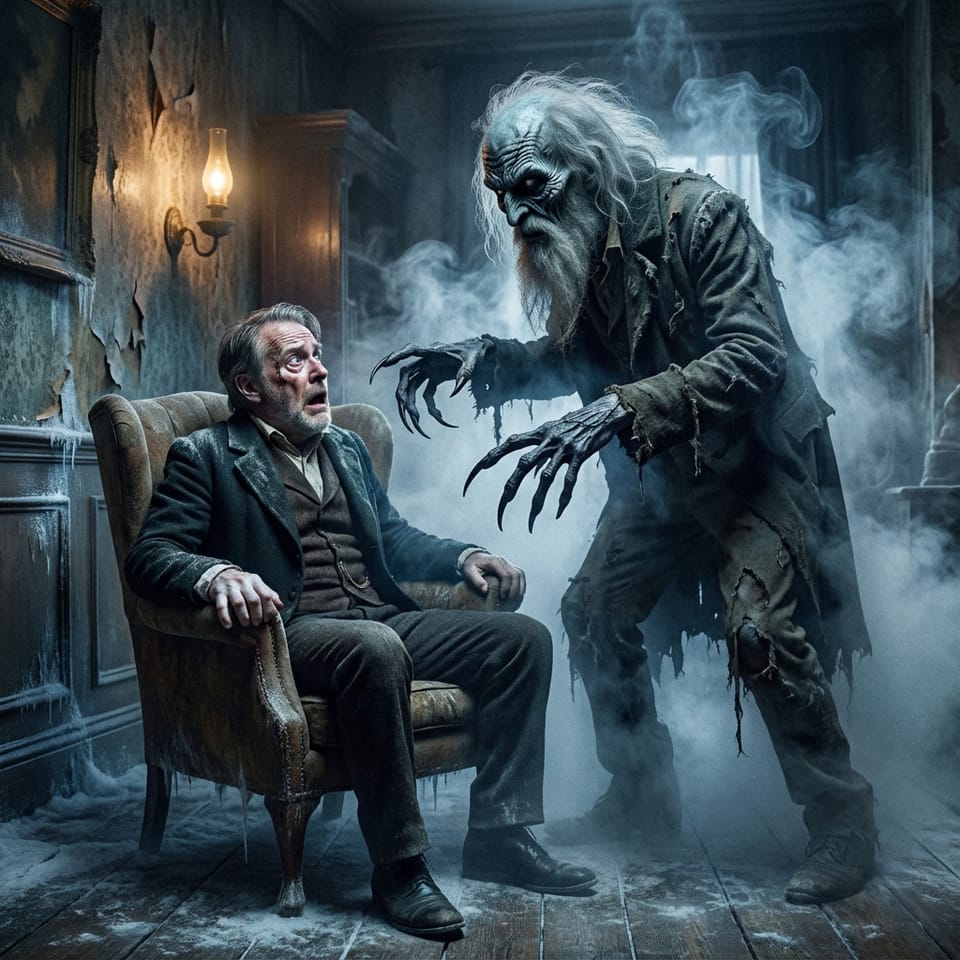
And then the clock stopped.
The fire dimmed, its flames freezing mid-flicker, a sculpture that gave no heat. The temperature plummeted. Bob's breath misted before him. Frost crept across his desk, across the ledgers that held the fortune he had built on another man's ruin.
A voice came from everywhere and nowhere:
"Bob..."
The name slithered through the room, soft as breath, cold as the grave. Bob rose, knocking over his chair. His heart hammered. His eyes searched the shadows.
"Who's there?" His voice cracked. "What devil are you? Show yourself!"
From the darkest corner, two eyes opened. White. Burning. Patient.
Slowly, a figure stepped forth. The clawed hands came first, gleaming like wet bone. Then the tattered robes, hanging like shrouds. Then the face: gaunt, hollow, stretched over a skull too sharp to be human, framed by a wild beard streaked with ash.
Bob's mind refused it. This was no man. This was something from a nightmare, from penny dreadfuls, from the stories mothers told to frighten children into goodness.
And yet.
The height. The stoop of the shoulders. Something in the way it stood, patient as a creditor awaiting payment. Something horribly, impossibly familiar.
"No," Bob breathed. "You're dead. You must be dead."
The creature tilted its head. When it spoke, the voice was gravel and tomb-dust, but beneath it, faint as an echo, lay the voice of a man Bob had once called master.
"Dead? Yes. The man you knew is dead. You saw to that, Bob. You and your ledgers. You and your patience. You and your grateful smile while you carved the meat from my bones."
Bob's legs buckled. He caught himself on the desk, scattering papers. "Mr. Scrooge? But... but you vanished. They said you died. They said..."
"They said what you wanted to hear." The creature stepped closer, and the shadows moved with it, pooling at its feet like something alive. "I did not die, Bob. I was unmade. And then I was remade. Into this."
It raised one clawed hand, turning it in the dim light, examining the talons as though seeing them for the first time.
"Do you like what your mercy purchased? Do you admire the fruit of your patience?"
"I helped you," Bob whispered, though the words tasted like ash. "I stayed when others left. I..."
"You stayed to pick the corpse." The white eyes flared. "You counted my coins while I wept. You tallied my fortune while I learned to feel. And when I had softened enough, when I had opened myself to the world as the Spirits demanded, you reached inside and took everything."
The room grew colder still. Bob could see his breath freezing into crystals that fell and shattered on the floor.
"That name you speak, Scrooge, is dust. Buried in the grave you dug. I am what remains. I am what crawled out."
The creature leaned close. Its breath smelled of crypts and centuries.
"I am Skroob. And I have come to balance the ledger."
The Warning
Bob fell to his knees. Words tumbled out, excuses, denials, pleas. "The children needed food. Martha needed medicine. I only took what you would have wasted. You were mad with generosity, giving to every beggar, every charity. Someone had to manage..."
"Someone had to steal." Skroob's voice cut like a blade. "Someone had to betray. Someone had to feast while I starved in the streets I once owned."
The shadows crept up the walls, smothering the paintings, the books, the trappings of stolen wealth. The room smelled of graves now, of earth and worms and the cold stones of paupers' crypts.
"I could kill you now," Skroob said, almost gently. "It would be easy. Your heart is racing so fast it might stop on its own."
Bob made a sound, not quite a word, not quite a sob.
"But death is too swift. Death is a mercy. And I have learned what becomes of mercy."
The clawed hand reached out and touched Bob's forehead. The touch was ice and fire and something worse: knowledge. In that instant, Bob saw himself as Skroob saw him. Every coin skimmed. Every lie told. Every night the old man had shivered in doorways while the Cratchits dined on his fortune.
Bob screamed.
Skroob withdrew his hand. The vision ended, but the knowledge remained, branded behind Bob's eyes.
"I will let you live with the knowing," Skroob said. "I have others to visit first. The Spirits who broke me. The world that watched and did nothing. But I will return, Bob Cratchit. When the ledger is full, I will return. And then we shall settle accounts."
The creature turned toward the window. The frost on the glass parted like a curtain.
"Tell your wife what haunts this house. Tell your children why the shadows know their names. Or say nothing, and let them wonder. Either way, they will learn. Everyone learns, in the end."
And then it was gone.
What Remained
The fire leapt back to life. The clock ticked. The frost on the windows remained, etched with a single word that would not melt until spring:
SKROOB.
Bob did not move for a long time. When his wife found him at dawn, he was still kneeling on the floor, staring at nothing, his lips moving without sound.
"Robert?" She touched his shoulder. "Robert, what happened? The children heard screaming."
He looked at her. His face had aged ten years in a single night. What could he say? That the man he had robbed had returned from death as a demon? That their fortune was built on bones that had risen to collect?
"A nightmare," he managed. "Only a nightmare."
She did not believe him. He could see it in her eyes. But she was a Victorian wife, trained not to press, trained to accept her husband's word as truth even when it tasted of lies.
"Come to bed," she said. "Whatever it was, it has passed."
But Bob knew better. It had not passed. It had only begun.
Outside, the fog lingered. And somewhere in its depths, moving toward the river, toward the place where Spirits had first come to a miser's bedroom five winters past, a figure walked.
Neezer Skroob had made his first haunting. And it was only the beginning.