The Accidental Cop
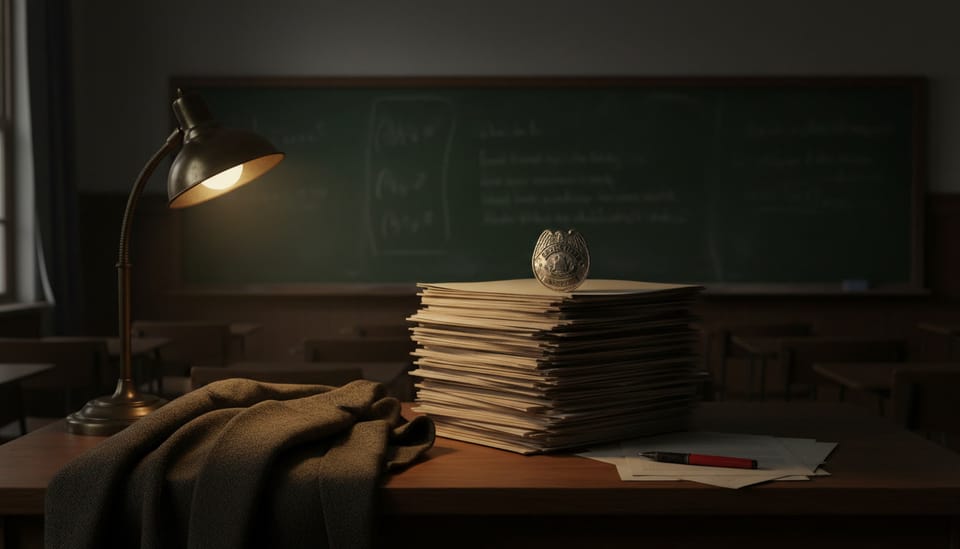
Every week, a new educator posts the same lament: students are self-silencing, lazy, giving their voices to corporations, or no longer willing to write. The language shifts a little, but the story stays the same. A modern classroom filled with essays the professor believes were shaped by AI, followed by frustration and a declaration that teaching has lost its joy.
There is a pattern behind these posts, and it tells a story more revealing than the words themselves.
The Job He Swears He Is Not Doing
The professor says he is not a cop. Then he describes the tasks of a cop: screening writing, judging intent, reporting students to academic authorities. His hands are tied, he claims. As if enforcement were a burden placed upon him rather than a choice.
It is a strange contradiction: refusing the label while performing the function.
The discomfort comes from a truth he cannot admit. He is not enforcing a rule. He is defending the belief that writing must originate in the untouched mind of the student to contain any value at all.
Once that belief cracks, the authority that rests on top of it begins to wobble.
The Voice He Claims to Protect
The professor says students are abandoning their voices. Yet he is the one silencing them. Refusing to grade work when he suspects it is touched by AI. Escalating cases even when the suspicion is nothing more than a feeling about tone or structure. Treating purity as the same as authenticity.
This is not the protection of human voice. It is nostalgia disguised as principle.
Writing has never been pure. Writers lean on books, peers, editors, teachers, templates, mentors, search engines, outlines, and every memory they have gathered across a lifetime. AI is only the first tool he cannot gatekeep, and that loss of control feels like an existential threat.
The Corporate Shield
He warns that AI tools are owned by wealthy corporations. The concern sounds righteous, but it hides a simpler fear: he no longer sits between the student and the act of writing.
The corporation argument appears only when a tool replaces the educator's monopoly. It does not appear for Turnitin, the plagiarism detection software that sells student writing back to institutions as training data. It does not appear for Canvas, which tracks every click and timestamps every hesitation. It does not appear for the textbook publishers who paywall knowledge behind access codes that expire each semester.
If the problem were truly corporate influence, the critique would reach far beyond student essays.
The problem is not the corporation. The problem is a shift in power.
The Laziness Accusation
A student wakes at five to open a coffee shop. She attends class at noon, then drives to a second job stocking shelves until close. Somewhere in the margins, she is expected to produce original thoughts on Victorian literature.
When she reaches for a tool that helps her draft faster, the professor calls it laziness.
He ignores the reality she lives in. Students work long hours. They support families. They juggle impossible schedules. They drown in debt.
Convenience is not a moral failure. It is a survival strategy.
Calling this moral decay reveals more about the professor than it does about the students.
The Real Loss
He says AI removes the joy from teaching. Tools do not do that. Suspicion does. Surveillance does. Measuring every sentence against an imagined threat does.
This is not a technological problem. It is an identity collapse. The professor once felt like a guide. Now he feels like a guard. That shift is painful, but it is not the student's fault.
A Different Path
The teacher who adapts will help students shape their voices with intention rather than fear. The one who clings to the old model will turn every class into a small courtroom.
He already chose. He just hasn't admitted it yet.