The Coming Age of Manufactured Understanding
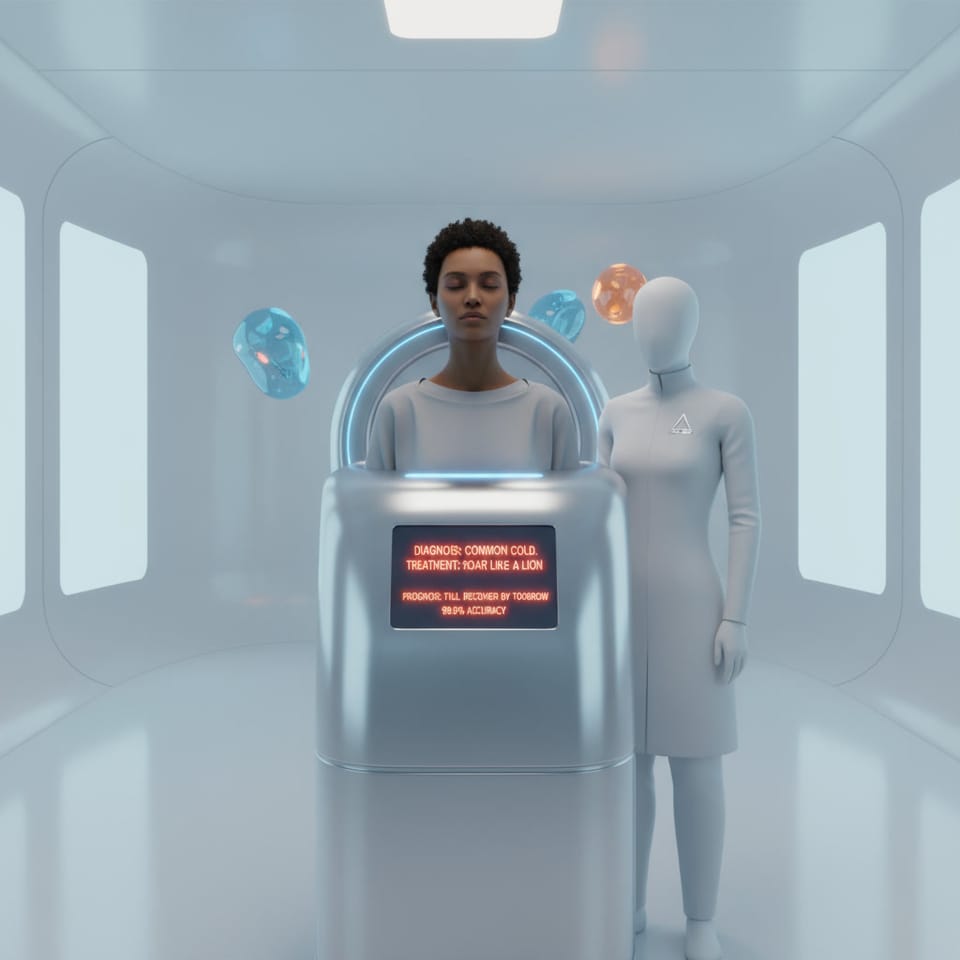
Artificial intelligence has been promoted as the next great leap in human progress. It promises speed, efficiency, convenience, and clarity. Yet the more society relies on it, the clearer the pattern becomes. The benefits are overstated. The costs are ignored. And the most serious of those costs are not financial. They are human.
The machine is not waking up.
People are falling asleep.
A civilization does not collapse from a single event. It erodes when the effort required for thought is handed to something else.
The Data that Feeds the Machine
AI does not think.
It sorts.
It predicts.
It mirrors.
The system can only return what it has been trained on, and the training data is rarely neutral. Medical databases are saturated with industry funded studies. News databases reflect the incentives of corporate media. Historical summaries tilt toward whoever writes the loudest narratives.
None of this requires malice. It only requires control over information.
If the data is biased, so is the output.
If the data is incomplete, so is the understanding.
If the data is shaped by powerful interests, the AI will amplify those interests with perfect confidence.
People trust AI because it speaks quickly and without hesitation. They assume speed equals objectivity. They assume clarity equals truth. In reality, the machine is only as honest as the institutions that built the pipeline.
This is how authority shifts quietly from human judgment to automated narrative.
When Skills Fade, Dependence Grows
Every decade removes another layer of personal skill. Mental math was replaced by calculators. Handwriting was replaced by keyboards. Research was replaced by search engines. Now writing, analysis, and understanding are increasingly replaced by AI.
Students can generate entire papers without reading the book. They do not need grammar. They do not need structure. They do not need the mental struggle that once shaped real education.
The same pattern shows up in the workplace.
Reports can be drafted by machines.
Emails can be written automatically.
Understanding becomes optional.
A society that cannot think independently becomes easy to steer.
The erosion is gradual.
The effect is permanent.
This is the world predicted in Idiocracy, not through inherent stupidity but through learned passivity. Once people stop practicing the skills that keep a civilization intelligent, the civilization begins its decline.
Protocols Replace Judgment
The most concerning shift appears in medicine, law, and infrastructure. These are fields built on judgment, context, and discernment. Yet the push toward automation is strongest here.
Hospitals already rely on rigid treatment paths.
Cities use automated models to manage power grids.
Regulatory agencies lean on algorithmic analysis to determine risk.
AI will accelerate this trend. It does not know how to distinguish rigorous science from corporate sponsored research. It cannot sense motive or conflict of interest. It pulls everything into a single stream and presents it as unified truth.
Doctors who rely on AI driven protocols will eventually default to the system rather than their training. Independent judgment fades. Medical freedom collapses. Patients become subjects of automated decision making.
This is not a distant scenario. It is a growing reality. AI does not seize control directly. It replaces the human need to think critically. Over time, that has the same effect.
A Population That Stops Thinking Cannot Remain Free
Every empire declines when its people lose discipline and curiosity. Technology speeds this process by making the difficult parts of life effortless. When a society embraces convenience without considering the cost, it becomes weaker.
The offshoring of manufacturing was sold as progress. The promised new jobs never appeared. The same pattern is repeating with AI. We are told that automation will bring new opportunities, yet there is no clear sense of what those opportunities are. Millions understand that the need for human labor is shrinking.
If people become economically unnecessary and intellectually passive, the outcome is predictable.
Control moves upward.
Autonomy disappears.
Education becomes ceremonial.
Thinking becomes outsourced.
Freedom becomes decorative.
The machine does not need to govern.
It only needs to replace the habits that once made self-government possible.
The Cost of Forgetting How to Think
This is the real danger.
Not intelligence created by machines, but intelligence abandoned by people.
Once thought feels unnecessary, authority becomes absolute. Authority does not need to censor what a population is unwilling to question.
If we want a future where technology supports humanity rather than replaces it, we must stay awake. AI can process information, but it cannot protect a society that refuses to think for itself.
The responsibility is still ours.