The Dinner Guest
There once was a man, rather proper and neat,
who sat down each night for sumptuous meat.
He dined upon pheasant. He feasted on veal.
He never once questioned the source of a meal.
"More butter!" he'd bellow. "More gravy! More bread!
More kidneys! More tongues from the recently dead!
More trotters! More sweetbreads! More fat from the roast!
I'll eat until I am a well-fattened ghost!"
And oh, how he ate. And oh, how he grew.
His belly ballooned. His waistcoat ripped through.
His buttons shot off like a volley of lead
and his chins became three, became four, became spread.
But here is the thing about hunger like his —
it doesn't stay put where you think that it is.
It starts in the belly, yes, tight as a drum,
but it moves. And it stretches. It doesn't stay numb.
It grows its own teeth and it grows its own eyes.
It fattens itself on the feast from inside.
He ate through the morning. He ate through the night.
He ate through the fog and the pale candlelight.
And sometimes — just sometimes — he'd catch on the wall
a shadow that didn't quite match him at all.
And once — only once — did he lift up his eyes
and the mirror above him delivered surprise:
a mouth slightly wider than mouths ought to be,
and teeth slightly sharper — but surely, thought he,
it's the candlelight playing its tricks upon me.
Now here is the part where the story grows queer,
where the candles drip low and the shadows draw near,
where the wallpaper peels and the last embers drop
and the grandfather clock ticks... then shudders... then stops.
For one dismal evening, in fog thick as paste,
the man took his seat with exceptional haste.
The ceiling stretched upward like lungs taking breath,
and the air tasted faintly of copper and death.
He looked at his plate, ornate, trimmed in gold,
and there on the porcelain — Loss to behold!
A shape. Something small. Something wriggling and pale.
Something screaming a tiny, impossible wail.
It was him.
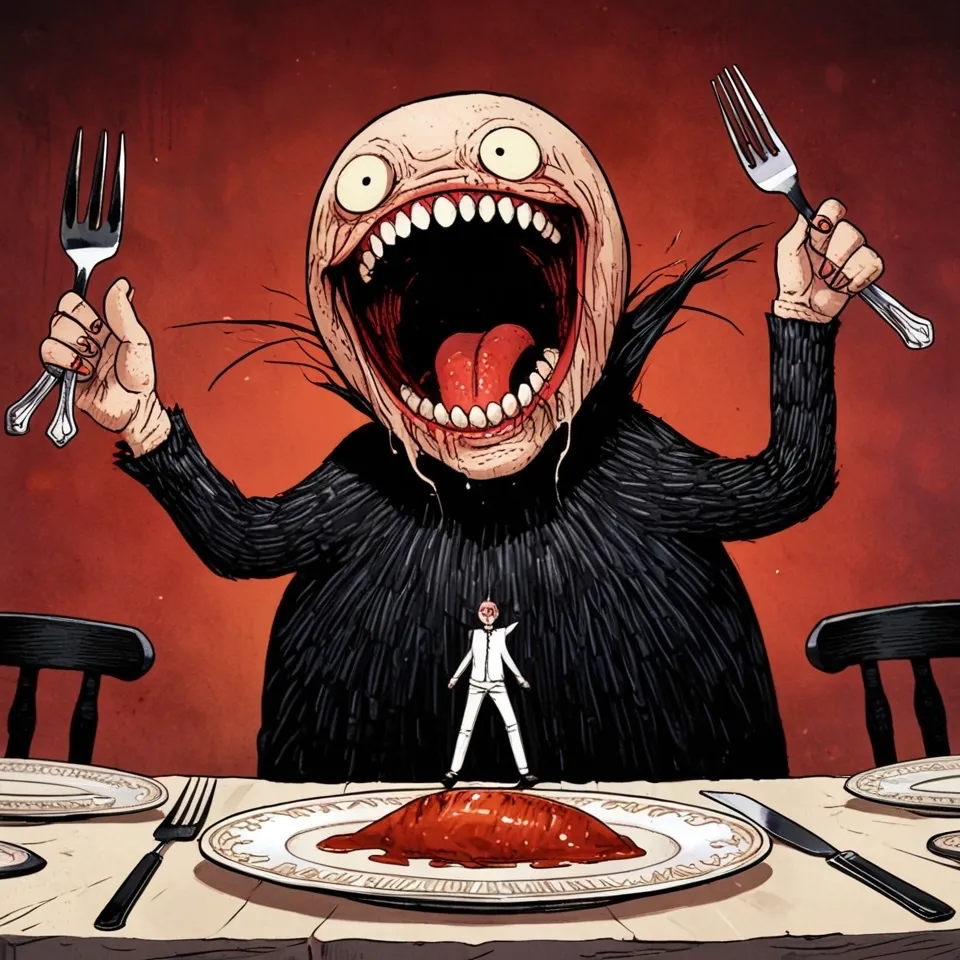
Not a roast. Not a bird. Not a ham.
But a miniature, trembling, ridiculous man
— in a waistcoat of white, with his arms open wide,
standing right in the sauce with nowhere to hide.
And ABOVE him — oh, ABOVE him — there loomed something vast,
something bulbous and ancient and built from the past,
with a head like a moon that had rotted and split,
and a mouth — blessed mercy — a MOUTH like a pit.
It grinned. And it widened. It widened some more.
It widened past anything widened before.
The teeth were like tombstones. The tongue dripped and gnawed.
Every supper still lodged in that bottomless maw.
Its eyes fell on Gerald with patience he knew,
he'd worn that same look every evening right through
ten thousand mad suppers, ten thousand blind days,
that same greedy, bottomless, famishing gaze.
It held up two forks in its terrible hands
and it drummed on the table — tap, tap — with demands,
the way HE had drummed on a hundred such nights
when the supper came late and the portions were light.
"Oh please!" cried the man on the porcelain plate.
"I am Gerald P. Glutton! You've made a mistake!"
But the creature just opened its jaws with a pop
and spoke in a voice that made Gerald's heart stop,
for it was Gerald's voice, only fatter and wetter,
as if something inside him had learned to speak better:
"...More. Butter. Please."
He tried to run then, but the sauce held him back.
He slipped on the jus and he fell with a crack
and he screamed at the creature through red-tinted black:
"I'll eat nothing that bleeds!
I'll eat nothing that cries!
I'll eat nothing that looks at me out of its eyes!"
But the creature just lowered that impossible face,
and Gerald looked up at the cavernous space
and saw, in the dark of that bottomless maw,
every meal he had eaten, still steaming and raw:
the lambs and the pheasants, the kidneys, the veal,
all watching him back from inside the last meal.
And he knew — oh, he KNEW — as the jaws opened wide,
that the thing bending down was himself from inside.
His appetite. His hunger. His bottomless greed.
Grown so vast, so monstrous, so bloated with need
that it split from his body and took its own seat
and turned Gerald P. Glutton to Gerald P. Meat.
The servants found nothing the following dawn.
No master. No plates. No crumbs on the lawn.
The napkin was folded. The silverware gleamed.
But the mirror still hung where it always had dreamed,
and the glass showed no face, no reflection at all.
Just a mouth. Hanging open. Still chewing the wall.
For the dinner, my dear, was not pigeon or hen.
Not brisket. Not mutton. Not pudding. Not wren.
The dinner that evening was Gerald himself
— served up by the hunger he'd kept on the shelf,
grown too clever, too hungry, too long left ignored,
till it sat itself down at the head of the board.
So be careful what appetites you choose to feed.
Be wary of gluttony. Watchful of greed.
For a hunger, once grown past the point of control,
doesn't just eat the body —
It swallows the soul.