The Fragile Machine
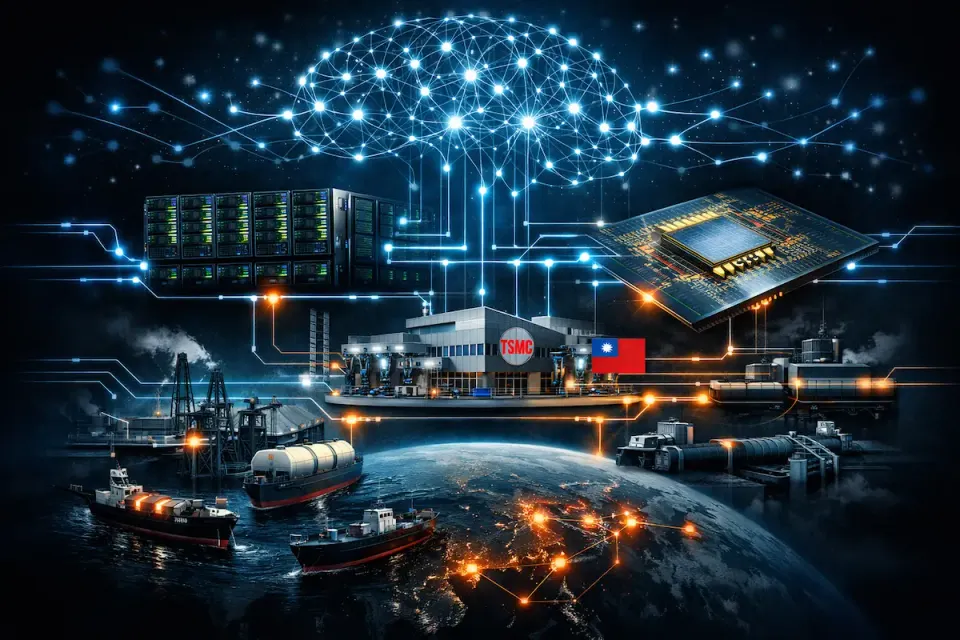
The Illusion of Digital Power
The AI revolution is often described as a software story. New algorithms. New models. New breakthroughs in machine learning. From the outside it appears almost weightless, as if intelligence has simply emerged from code and computation. A new digital layer quietly settling over the world.
But this impression is misleading.
Artificial intelligence does not float in the cloud. It sits on the ground.
The Physical World Beneath the Digital One
Every AI system begins with hardware. Not the models themselves, but the processors that run them. Vast data centers filled with thousands of chips, consuming power on the scale of small cities.
The most advanced models are trained on specialized semiconductors designed by NVIDIA and manufactured by Taiwan Semiconductor Manufacturing Company. These chips are the result of one of the most complicated production processes humanity has ever created. They require ultra-pure silicon, rare industrial gases, precision manufacturing measured in nanometers, stable electricity, and global logistics networks.
Each step depends on factories, infrastructure, and geopolitical stability. Remove any of those layers and the digital world begins to slow.
When Compute Became the Fuel
Over the last decade, researchers discovered something surprising. When machine learning models were scaled with more data, larger networks, and greater computational power, their capabilities improved dramatically. Language models learned to reason across text. Image models began generating photorealistic pictures. Systems could write, translate, summarize, and analyze.
But achieving these results required vast computational resources. Training the largest models now involves clusters containing tens of thousands of processors running continuously for weeks or months.
Compute became the new fuel of the digital economy. And like all fuels, it has a physical source.
Why GPUs Matter
Graphics processing units were originally designed for rendering video game graphics. They turned out to be unusually well suited to machine learning. Their architecture allows thousands of mathematical operations to run in parallel. Neural networks, which depend on large matrix calculations, benefit enormously from that parallelism.
As a result, GPUs evolved from gaming hardware into the central infrastructure of the AI era. Companies including NVIDIA, Microsoft, Google, and Meta now build or operate massive clusters of these chips. Each new generation of models requires more of them. The pace of AI progress is increasingly tied to the ability to manufacture and deploy these processors.
The Manufacturing Constraint
Designing an AI chip is difficult. Manufacturing one is far more difficult.
Most advanced processors are fabricated using extremely precise semiconductor processes available at only a few facilities in the world. Inside those factories, silicon wafers move through hundreds of steps: photolithography, etching, deposition, ion implantation, chemical polishing. Each layer must align with extraordinary precision. The structures etched into the silicon are measured in nanometers, layers of circuitry so small that thousands could fit across the width of a human hair.
The most critical step in this process is lithography: projecting circuit patterns onto silicon using light. The machines that perform the most advanced version of this work are made by a single company, ASML, based in the Netherlands. Its extreme ultraviolet lithography systems are among the most complex machines ever built. Each one costs hundreds of millions of dollars, requires multiple planes to transport, and must be maintained by ASML engineers on site. No other company in the world can produce them. Without these machines, the most advanced chips cannot be made.
Producing these chips also requires ultra-clean environments, rare industrial gases, specialized chemicals, and highly stable electricity. Each fabrication plant costs tens of billions of dollars and takes years to construct. The expertise required to operate them cannot be developed overnight.
Even after chips are fabricated, another constraint appears. Modern AI processors rely on advanced packaging technologies that combine multiple chips into tightly integrated modules capable of moving data at extreme speed. These processes require precise assembly techniques and additional manufacturing capacity, much of which is concentrated in the same regions that fabricate the chips themselves.
The Invisible Supply Chains
Behind every AI model is a production chain stretching across continents. Silicon wafers produced in Asia. Lithography equipment from Europe. Specialty gases refined from global chemical plants. Metals mined from Africa and South America.
The system functions only because these pieces move smoothly across the world. Shipping lanes remain open. Factories remain powered. Political systems remain stable enough to support trade.
This arrangement has become so normal that it is easy to forget how fragile it is.
Data Centers Are Buildings
When people hear the word “cloud,” they imagine something intangible. In reality the cloud is concrete and steel.
Inside are rows of servers connected by fiber networks and cooled by massive ventilation systems. Modern AI training systems can fill entire buildings with tens of thousands of GPUs, petabytes of storage, high-speed networks, and advanced cooling infrastructure. Some of the newest AI facilities draw hundreds of megawatts, approaching the energy consumption of entire towns.
What began as a research problem in computer science has become a major industrial undertaking.
The Energy Layer
Beneath the chips and the data centers sits something even more fundamental. Energy.
Every part of the AI economy runs on the steady flow of electricity and fuel. Training large models requires computing clusters operating continuously for weeks or months. Semiconductor fabrication plants depend on stable power to maintain delicate manufacturing processes. Global supply chains require fuel to move materials across oceans.
In many regions, natural gas remains one of the most reliable source of large-scale power generation. As AI infrastructure expands, the demand for stable energy grows with it. The digital world, despite its abstract appearance, has a very physical appetite.
Energy systems also support the chemical industries that produce specialized gases used in semiconductor manufacturing. Certain fabrication processes rely on gases such as neon, helium, and hydrogen, which play critical roles in laser systems used in photolithography and cooling processes required in advanced equipment. The supply chains that produce and refine these gases are closely linked to heavy industry and petrochemical processing. When those industries experience disruption, the availability of these materials can tighten. For semiconductor manufacturing, even small shortages can create delays.
Energy Geography
Energy markets have always been shaped by geography. Major reserves of oil and natural gas are concentrated in a handful of regions. One of the most important is the Persian Gulf, where countries sit along key maritime routes used to transport fuel across the world.
When tensions rise in these regions, the effects rarely remain local. Energy prices fluctuate. Shipping routes become more expensive or uncertain. Industrial supply chains adjust to new risks. Higher electricity prices raise the cost of operating large data centers. Disruptions to petrochemical industries can affect the supply of specialized gases used in fabrication. Shipping disruptions can slow the movement of equipment and materials required for chip manufacturing.
None of these factors alone stops technological progress. But together they introduce friction into a system that depends on precision, timing, and stability.
The Taiwan Semiconductor Trap
All of these layers of dependency converge in one place.
Among the world’s specialized foundries, Taiwan Semiconductor Manufacturing Company stands apart. Today the company produces the majority of the world’s most advanced chips. Designers such as NVIDIA, Apple, and AMD rely on TSMC’s fabrication plants to turn their designs into physical hardware. Without those factories, the global technology industry would slow dramatically.
Most of TSMC’s advanced fabrication capacity sits on the island of Taiwan. This concentration creates extraordinary efficiency for the global technology industry. Designers, suppliers, and logistics networks have evolved around this ecosystem.
But it also creates a strategic dilemma. Taiwan lies at the center of an increasingly tense geopolitical environment. The government of China views Taiwan as part of its territory, while the United States and its allies maintain strong economic and security ties with the island.
This situation has produced what might be called a technological version of mutual deterrence. China depends on the global semiconductor supply chain to support its own industries. Disrupting Taiwan’s chip production would harm not only its rivals but also its own technological development. At the same time, the United States and its allies rely heavily on Taiwanese fabrication for advanced computing hardware.
A major disruption to these factories would ripple through the entire global economy. Smartphones would be delayed. Data centers would struggle to expand. Automotive electronics would tighten. AI hardware production would slow dramatically. The destruction of this semiconductor ecosystem would damage nearly everyone.
The paradox is clear. The global technology system has concentrated its most advanced manufacturing capability in a location that sits within one of the most sensitive geopolitical regions in the world. This concentration was not designed intentionally. It emerged gradually as companies optimized for efficiency, cost, and technical expertise. But the result is a strategic bottleneck.
The Strategic Turn
For much of the early discussion around artificial intelligence, the technology was framed as a tool. A powerful tool, certainly. But still something used primarily for research, business productivity, and scientific discovery.
That perception is changing. Governments are increasingly viewing AI not just as innovation, but as strategic infrastructure. Throughout modern history, certain technologies have reshaped global power. Industrial manufacturing altered the balance between nations in the nineteenth century. Oil reshaped geopolitics throughout the twentieth. Nuclear technology introduced an entirely new dimension of strategic deterrence. Artificial intelligence may represent the next phase in that pattern.
The two largest competitors are the United States and China. Both view artificial intelligence as central to their future economic and technological leadership. This competition has already produced export controls on advanced semiconductors, restrictions on technology transfer, and government investment in domestic chip production.
The dynamic is familiar. When one country develops a powerful new capability, others accelerate their own development in response. Advances in AI can influence military planning, cyber operations, surveillance systems, and economic forecasting. Each improvement creates incentives for other states to keep pace. Control over chip design and fabrication increasingly determines who can build the most advanced systems. For this reason, semiconductor manufacturing is now viewed through the lens of national security.
Much of this competition unfolds quietly. Research investments. Semiconductor policy. Data center construction. These developments rarely attract the attention that accompanies more visible geopolitical events. Yet they may shape the balance of technological power for decades.
The Polycrisis Machine
By this point, the pattern becomes difficult to ignore.
The modern AI ecosystem rests on three critical foundations: energy, semiconductors, and geopolitical stability. Each supports the others. Data centers require enormous electricity to operate. Semiconductor fabrication plants require stable power and complex industrial inputs. Global supply chains require relatively stable political relationships to function smoothly.
Individually, each of these challenges can usually be managed. Energy markets adjust. Manufacturing disruptions are repaired. Diplomatic tensions rise and fall. But when several pressures occur simultaneously, they can reinforce one another. Energy disruptions can affect manufacturing. Manufacturing disruptions can affect semiconductor supply. Semiconductor shortages can slow technological development. Geopolitical tension can disrupt all three at once.
This interaction between systems creates what analysts increasingly describe as a polycrisis — a situation in which multiple disruptions amplify each other rather than remaining isolated.
The machines that think still rely on the machines that build them. And those machines live in the real world.
— no-one
Thoughts you didn't think, written for you anyway
Related essays:
The Fragile Machine: The Demographic Trap
The same fragility argument, turned toward the workers who build and maintain the machine.
Zero One: The Taiwan Semiconductor Trap and the Logic of Mutual Destruction
A closer look at the single chokepoint this essay only sketches.
When the World Itself Wakes Up: How AI Turns the Planet into a Thinking System
What happens when the fragile machine grows large enough to become a planetary nervous system.