The Hidden Judgment Work of Histotechs
The slide only looks simple
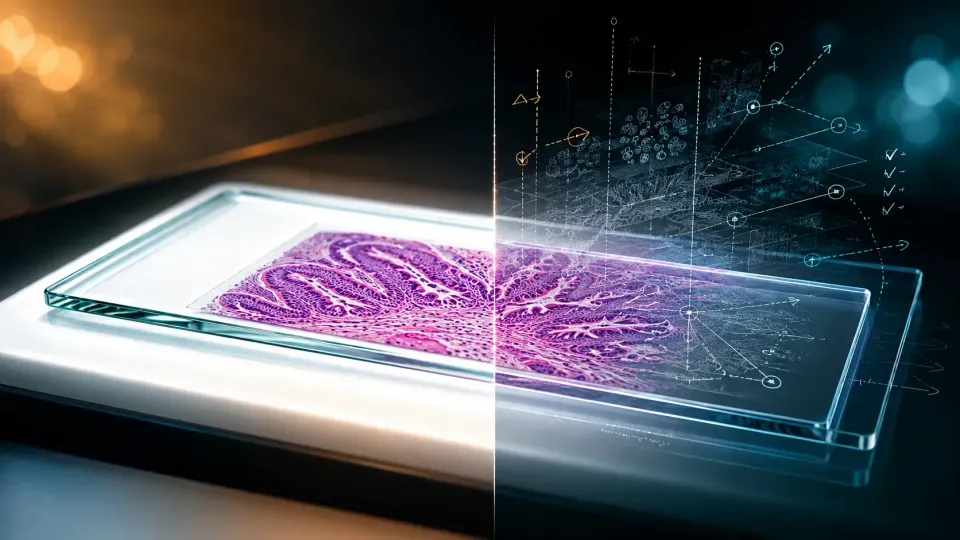
A finished slide can make histotechnology look deceptively straightforward. A piece of tissue is fixed, processed, embedded, cut, stained, coverslipped, and delivered. To anyone outside the lab, it reads as a sequence of manual steps. A craft, maybe, but a mechanical one.
Every good histotech knows the truth behind that impression: the slide only looks simple because the judgment work has already been done. Before a pathologist, a researcher, a biomarker lead, or a toxicologic pathologist ever interprets the tissue, the histotech has already made a chain of decisions that determine whether that interpretation is possible, reliable, and defensible. The visible work is cutting, staining, embedding, labeling, and loading instruments. The invisible work is judgment, and it is the part that actually carries the quality.
That judgment is not diagnosis. A histotech is not deciding what the disease is. The histotech is deciding something prior and equally consequential: whether the tissue preparation is technically trustworthy enough for someone else to interpret at all. Histotechnology is undervalued precisely because its most important skill is the one no one sees.
What "hidden judgment work" actually means
Hidden judgment work is the set of decisions that rarely make it into a job description but determine whether a slide is fit for its purpose. It shows up as a running series of questions the tech answers, often in seconds, often without naming them. Is this tissue fixed enough to process, or will the schedule tear through underfixed tissue? Is the specimen oriented correctly for the diagnostic or study question? Is the section deep enough, or am I looking at the edge instead of the lesion? Is this fold acceptable, or does it obscure exactly the area that matters? Is the stain genuinely weak, or is the biology weak and the stain doing its job honestly? Is the control acceptable? Is the artifact technical, biological, or pre-analytic? Should this be repeated, recut, escalated, or documented? And ultimately: is this slide good enough for diagnosis, for biomarker interpretation, for toxicology review, or for image analysis, because the answer can differ depending on which one you mean?
None of that is mechanical labor. It is applied technical reasoning under real constraints: limited tissue, limited time, and downstream consequences the tech may never directly see.
Clinical histology: judgment under patient-care pressure
In the clinical lab, that judgment protects diagnosis. A clinical histotech works inside a patient-care system where turnaround time is a genuine pressure and accuracy is non-negotiable, and the tech is constantly balancing the two.
It begins before a single section is cut. At accessioning, the tech is the first person positioned to notice a mismatched tissue type, the wrong container, poor or delayed fixation, an unusual specimen size, or a handling problem that will compromise everything downstream. At embedding, orientation quietly determines what the pathologist will be able to see; skin margins, GI biopsies, prostate cores, breast tissue, bone marrow, and tiny biopsies each demand a different decision about plane and surface, and a wrong call there is not always recoverable. At the microtome, the tech is the one deciding when a section is good enough and when it is not, judging chatter, compression, folds, floaters, sections that are too thick, knife marks, and incomplete facing against whether they actually touch the area of interest.
Staining adds another layer. The tech judges whether an H&E, a special stain, or an immunohistochemical result is acceptable: recognizing control failure, uneven or weak staining, excessive background, precipitate, drying artifact, or an instrument that has started to drift. And threaded through all of it is escalation. A strong histotech knows when to stop and ask a pathologist, supervisor, grossing tech, or senior colleague before exhausting irreplaceable tissue or releasing a slide that should not be trusted. Knowing when not to proceed is itself a skill.
Pharma histology: judgment under scientific and regulatory pressure
In pharma and research settings, the same judgment protects something different: data integrity. Here the slide is not supporting a single patient's diagnosis. It may underwrite drug-safety assessment, toxicology findings, mechanism-of-action work, biomarker development, target-expression studies, xenograft or animal-model interpretation, digital image analysis, a regulatory submission, or a go/no-go decision on an entire program.
In that context, technical quality silently converts into scientific conclusions, and the failure modes are dangerous because they look like biology. A weak stain can be read as low target expression. Poor fixation can masquerade as antigen loss. Background can be mistaken for true signal. Bad orientation can render a lesion or region of interest impossible to evaluate, so it simply isn't. The pharma histotech is often the only person in a position to protect the study from false confidence, to recognize that a clean-looking result rests on a preparation that cannot actually support it. That role sits inside a regulated environment, where nonclinical safety studies are expected to meet Good Laboratory Practice standards for how work is conducted and documented, and where the credibility of a finding depends on the traceability and quality of the tissue behind it.
The shared foundation is trust
Clinical and pharma histology have different end users, but they rest on the same foundation, and it is a single word: trust. The pathologist has to trust that the slide represents the tissue. The researcher needs the stain to reflect biology, not artifact. The biomarker lead is counting on positive and negative staining to each mean something specific. The toxicologic pathologist is relying on handling, sectioning, staining, and documentation that did not quietly compromise the interpretation.
That trust is not generated by the instrument, and it is not generated by the protocol. It is built at the bench, by a person making judgment calls. The published quality guidelines that govern this work, for immunohistochemistry validation, for biomarker testing, for digital pathology, all assume a competent technical floor underneath them. They describe what reliable preparation should look like but cannot themselves produce it.
Judgment runs through every stage of the workflow
The hidden judgment is not concentrated at one step. It runs the length of the workflow, and each stage asks a different question.
At fixation, the tech recognizes tissue that is underfixed, overfixed, dried, delayed, or improperly decalcified: pre-analytic variables that the rest of the pipeline cannot undo and that biomarker testing is especially sensitive to. At processing, the tech detects tissue that is brittle, mushy, poorly dehydrated, or overprocessed, and knows when standard schedules will not serve it. At embedding, the tech sets the plane of section and preserves the diagnostic or study-relevant surface, because the wrong plane can hide the only thing that mattered. At microtomy, the tech decides how much to face, how many levels to cut, and whether artifact has crossed from cosmetic to interpretively disqualifying.
At staining and IHC, the tech separates reagent failure from tissue variables, instrument issues, control behavior, and expected biology, evaluating controls, background, localization, intensity, and tissue preservation to confirm the assay actually worked before anyone interprets it. This is exactly the territory that CAP's own analytic-validation guidance for immunohistochemical assays addresses; that guidance exists because the gap between "a stain ran" and "a stain is trustworthy" is real and consequential. And at the digital pathology stage, the stakes compound: section quality, staining consistency, coverslipping, tissue folds, and scan focus determine whether an image-analysis algorithm produces meaningful data or confident garbage. Validation guidance for whole slide imaging assumes the glass feeding the scanner is sound; the algorithm cannot rescue a slide the histotech would have rejected.
Why the work stays invisible
If this judgment is so central, why does it stay hidden? Several reasons compound.
The first is structural: successful judgment prevents problems, and prevented problems leave no trace. Catch the issue at fixation and the error never becomes visible, so the save never gets counted. The second is the product itself. A beautiful slide does not show the decisions that made it possible; it shows only the result. The third is institutional framing: many organizations describe histology as production work, and productivity metrics count blocks, slides, stains, and turnaround time far more easily than they capture judgment. The fourth is how the skill is learned. Histotechs acquire judgment through experience rather than formal recognition, and the better they get, the more natural and effortless their decisions look, which reads, to an outside observer, like the decisions weren't hard. The fifth is where credit flows. Recognition attaches to the final interpretation, not to the technical preparation that made the interpretation possible in the first place.
The cost of treating histology as simple production
When management treats histology as repetitive production, a predictable set of consequences follows: understaffing, unrealistic turnaround expectations, thin training, overreliance on automation, no protected time for troubleshooting, and the slow loss of senior expertise. Downstream, that shows up as higher repeat rates, more pathologist frustration, weaker biomarker and study data, and an increased risk of diagnostic or scientific error. The cruel part is that the lab can look more productive while this happens. The metrics that are easy to count stay healthy while the quality that is hard to measure erodes quietly underneath them.
A trained histotech is not a task operator
This is the line that separates a trained histotech from a task operator: an operator can follow the steps, while a histotech understands why the steps matter. The difference is invisible on a good day and decisive on a bad one. It surfaces the moment something goes wrong, when tissue behaves unexpectedly, staining shifts, controls fail, instruments drift, samples run short, or the study question changes mid-stream. The value of the histotech is not only in running the protocol correctly. It is in recognizing when doing everything right still did not produce a trustworthy result.
What this looks like in practice
A few concrete cases make the judgment legible.
Clinical. A tiny GI biopsy comes through with folds running across the epithelium. The slide technically contains tissue, but the region needed for interpretation is compromised. The hidden judgment is knowing that "tissue present" and "diagnostically useful" are not the same statement, and acting on the difference before the case is signed out on inadequate material.
Pharma. A xenograft IHC stain shows high background using a mouse primary antibody and a broad detection system. The hidden judgment is recognizing that the apparent positivity may reflect detection-system cross-reactivity or model-related background rather than true target expression, and flagging it before it is read as a result.
Biomarker. A sample that previously stained positive for a marker now stains negative with a different clone and detection system. The hidden judgment is knowing that this cannot be interpreted as simple biological loss without first weighing clone, epitope retrieval, fixation, detection chemistry, tissue age, and control behavior. This is the exact reasoning that standardized biomarker guidelines are built to discipline, for HER2 and for estrogen and progesterone receptors, where the validity of a call depends heavily on controlled, well-understood preanalytic and analytic conditions.
Digital pathology. An image-analysis algorithm fails, or worse, succeeds confidently on bad input, because folds, chatter, uneven staining, or poor scan focus have distorted the tissue. The hidden judgment is knowing that digital output is only ever as reliable as the physical slide and scan feeding it, and that the place to catch the problem was the bench, not the dashboard.
Senior histotechs are institutional memory
Senior histotechs often function as an informal quality system that no org chart acknowledges. They know which tissues need special handling, sense when an instrument is drifting before QC formally fails, and remember what a given stain is supposed to look like on a good day. Ask them, and they can tell you which pathologists want deeper levels, which specimens are easily exhausted, and which artifacts mimic disease or signal convincingly enough to fool someone newer. That accumulated knowledge is institutional memory, and it is load-bearing. When senior histotechs leave, the lab does not simply lose a pair of hands. It loses judgment that took years to build and cannot be re-hired quickly.
What should change
Recognizing this work is not sentimental; it is a quality argument. Histotech judgment should be made explicit in job descriptions, competency assessments, training programs, compensation, and staffing models. It should be reflected in the quality metrics labs actually track, in how pharma studies are planned, in how clinical turnaround expectations are set, and in how IHC and digital pathology validations are designed and staffed. And it should be visible in cross-functional conversations, where histotechs are treated as technical interpreters of preparation quality rather than as interchangeable hands at the end of a line. The standards the field already relies on, including CAP and CLIA frameworks, IHC and WSI validation guidance, and biomarker testing guidelines, implicitly depend on that judgment being present and competent. It is worth naming the people who supply it.
The work is hidden, not simple
The pathologist's diagnosis, the biomarker lead's confidence, the toxicologic pathologist's finding, and the researcher's conclusion all rest on the same quiet foundation: a slide that can be trusted. That trust is not created by the instrument or the protocol alone. It comes from the histotech's judgment, from a series of decisions made early enough that, when they're right, nothing downstream ever has to think about them.
The work is hidden because when it is done well, the slide simply works. But hidden does not mean simple. And it should never mean invisible.