Ink and Code Part 1: The New Literary Puritans
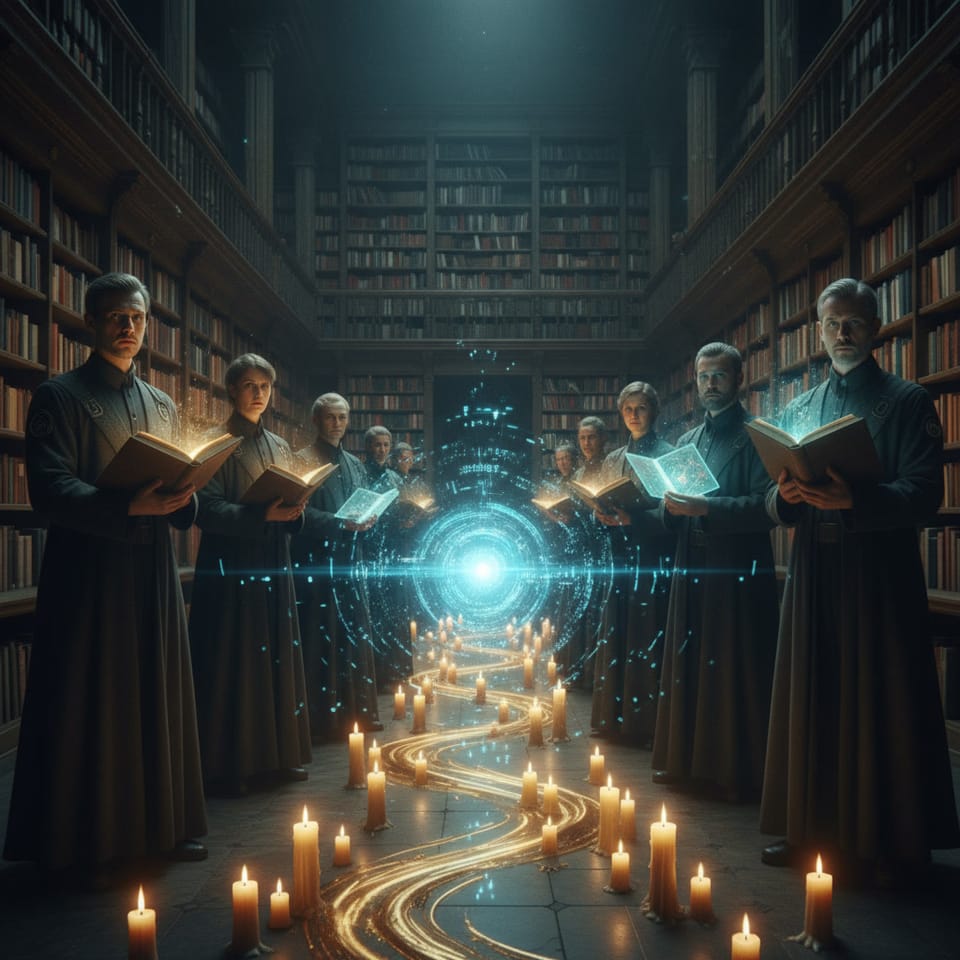
There is a new kind of gatekeeper rising in the world of literature. They do not call themselves censors, or critics, or arbiters of taste. They prefer softer words: curators, guardians, defenders of authenticity. They speak of creative integrity, of the sanctity of lived experience, and of their duty to protect the human voice from the creeping imitation of machines.
Their language is gentle, but their posture is familiar. It is the posture of purity, the belief that art must be protected from contamination, that something sacred is at risk, that certain tools or methods are too impure to produce something real.
And yet, beneath the hymns to authenticity, beneath the moral perfume of their arguments, something else lingers: a fear not of corruption, but of displacement. The new literary puritans are not defending humanity. They are defending a hierarchy.
The Gospel of Authenticity
Authenticity has become the currency of contemporary art. Writers are told to find their voice, but the market has decided what kind of voice is acceptable: one drawn from lived experience, one that signals moral legitimacy through proximity to pain or identity. The mantra is simple: write what you know. But what began as an invitation to empathy has hardened into a border.
To write beyond one’s own biography is increasingly seen not as imaginative but as presumptuous. Fiction, once defined by its freedom to inhabit other minds, now risks being judged by its provenance.
This obsession with authenticity has little to do with art. It is about authority. To claim ownership of truth, to decide who is authentic enough to speak, is to wield power over what counts as real. In that sense, the cult of authenticity is a new form of classism: it rewards the few who already fit its definition and excludes those who do not.
The puritans of authenticity have found their new heresy in the rise of AI-assisted writing.
The Machine as Scapegoat
The arrival of generative AI has unsettled the literary world like few technologies before it. Here is a machine that can mimic the rhythms of prose, the shape of argument, even the tremor of emotion. It can compose stories, essays, and poems, sometimes clumsy, sometimes astonishingly deft.
For some, this is thrilling. For others, it is sacrilege.
The new literary puritans insist that such writing is soulless, synthetic, devoid of human feeling. They frame their rejection as a moral duty, a defense of art’s sacred core. But moral panic, in art, often hides something more fragile: status anxiety.
If a writer can create something moving with the help of a machine, what happens to the critic’s role as arbiter of what is real? What happens to the myth of the chosen few, those born with the ineffable spark of genius?
AI does not threaten humanity. It threatens the hierarchy that decides who gets to define humanity.
Purity and Power
The rhetoric of purity has always been political. In every era, it appears as a defense of order against perceived chaos, whether moral, cultural, or technological. When photography emerged in the nineteenth century, painters declared it a mechanical imitation of life, unworthy of art. When digital instruments entered music, purists called them sterile. When e-books appeared, traditionalists said they would destroy the soul of reading.
Each time, the defenders of purity were proven wrong. Each time, art expanded.
But the pattern repeats because purity is never really about art. It is about control, the power to decide where the boundaries of legitimacy lie.
Today’s literary puritans, cloaked in the language of creative integrity, are performing the same old ritual: policing the borders of art to preserve their sense of superiority. They believe they can hear the difference between a real voice and a synthetic one, and that belief flatters them. It casts them as priests of discernment in an age of confusion.
But the truth is more inconvenient. Authenticity has never been about the tools used. It has always been about intention.
Intention, Not Instrument
Every story begins with the same question: What does it feel like to be alive?
That question does not vanish when a writer uses AI. The machine may generate the sentence, but it does not know what it means. The intention, the emotional spark, the act of choosing what matters, that remains human.
A novelist using AI to rephrase a passage, a poet experimenting with rhythm through a model, a journalist using it to test clarity, these are not acts of replacement but of extension. The machine widens the field; the writer still decides where to walk.
To argue otherwise is to confuse creation with execution. The typewriter, too, automated the hand; the word processor automated the line break. Each tool changed the rhythm of writing, and each time, the puritans cried that the craft was being lost.
But writing is not a craft of hands. It is a craft of mind.
The Fear of Losing Control
The fear that AI will replace writers is not really about economics, though that concern is valid. It is about ego. It is the fear that meaning will no longer require the credentialed interpreter, that art might become too democratic, too abundant.
When creativity is accessible to everyone, the critic’s power to anoint becomes irrelevant. The puritans lose their priesthood.
And so they disguise their anxiety as ethics. They speak of protecting the human voice, when what they really mean is protecting their role as its gatekeepers. They lament that AI can mimic emotion, not because they truly believe art is mechanical, but because they fear the realization that emotion in language has always been a system of imitation, that sincerity itself is a form of performance.
The poet chooses words that sound spontaneous but are crafted. The novelist builds empathy from artifice. The playwright writes dialogue meant to feel improvised. Every act of art is an act of simulation in service of truth.
The machine does not desecrate that ritual; it only mirrors it back to us.
The Myth of the Solitary Genius
The puritans’ fear also rests on another myth: the myth of the solitary genius.
We like to imagine the writer as a singular figure, candlelit desk, divine inspiration, the tortured mind alone with its muse. It is a romantic image, but it is fiction. No writer creates in isolation. Every story is built from borrowed language, shared symbols, collective memory. We write not from nothing, but from everything we have read, seen, and felt.
AI simply makes that collective process visible. It shows us what our art has always been: a network of influence, a conversation across time.
To collaborate with a model trained on the corpus of human writing is not to erase the human voice; it is to engage with the vast, echoing chorus of it.
When the Hierarchy Trembles
The democratizing power of AI in art is both its beauty and its threat. Suddenly, people who never thought of themselves as writers can produce language that moves, persuades, even inspires. The distinction between writer and reader, artist and audience, begins to blur.
For institutions built on those distinctions: publishers, universities, cultural gatekeepers, this is destabilizing. The hierarchy trembles.
But this trembling is not a crisis. It is a renewal. Art grows not by enforcing purity, but by absorbing impurity, by allowing the strange, the hybrid, the imperfect to enter.
The same fear once met the arrival of jazz, collage, photography, graffiti, and hip-hop. Each time, the establishment called it inauthentic. Each time, the world proved them wrong.
Authenticity Reimagined
Perhaps it is time to abandon the idea of authenticity as a static virtue and see it instead as a dynamic relationship. Authenticity does not mean untainted. It means true to the artist’s intention.
A poem written with AI can be deeply authentic if it expresses a genuine emotion, idea, or curiosity. A story typed entirely by hand can be hollow if it serves only to signal moral superiority.
The question is not “Was this made by a machine?” but “Does this move me?”
To conflate process with purpose is to mistake the costume for the character.
The Empathy Paradox
Ironically, the obsession with lived experience, a phrase the puritans worship, often leads to less empathy, not more.
If a writer can only write from their own perspective, then fiction ceases to be an act of empathy and becomes one of autobiography. The whole point of art, to imagine another life, another world, another way of being, is lost.
AI, for all its flaws, offers an unexpected counterpoint. It allows us to step outside ourselves, to experiment with language beyond our habits, to simulate voices we might not otherwise hear. Used thoughtfully, it can be an empathy machine, a tool for exploration, not imitation.
To forbid that is to fear precisely what literature exists to do: to transcend the self.
The Future of the Human Voice
There will always be those who claim that art must be pure to be meaningful. But purity is a dead end. The vitality of art lies in its contamination, in its ability to merge, mutate, and evolve.
AI will not destroy literature. It will multiply it. It will create new genres, new collaborations, new ways of thinking about authorship. Some of what it produces will be terrible. Some will be transcendent. That is as it has always been.
The human voice will not vanish. It will simply find new frequencies.
A New Kind of Authenticity
The real task ahead is not to defend human art from machines, but to redefine what human art means. Authenticity will no longer depend on the purity of creation, but on the clarity of intention.
The writer of the future may be part author, part conductor shaping the flow of generative tools into meaning. The artist will become less a solitary genius and more a creative architect, orchestrating collaboration between intellect and algorithm, emotion and form.
This is not a loss. It is an evolution.
The End of Ownership
What unsettles the new literary puritans most is not the idea that AI can create, but that creation might become shared.
For centuries, the artist has been the owner of meaning, the singular author of a work’s moral and aesthetic value. AI undermines that ownership. It distributes it. It reminds us that art was never truly private to begin with, it was always collective, born from culture, language, and time.
What threatens them is not the loss of art, but the loss of ownership over its definition.
Toward Creative Plurality
The future of art will not be pure or impure, human or machine, authentic or synthetic. It will be plural, a vast ecosystem of creative methods, voices, and forms.
The writers who thrive will be those who understand that tools are only as meaningful as the hands that wield them. They will see that the essence of creativity lies not in isolation, but in relation between minds, between mediums, between generations of thought.
The new literary puritans will fade, as every orthodoxy eventually does. Their boundaries will dissolve under the weight of art’s endless curiosity.
And somewhere, in the blurred space between human and machine, the oldest question will remain unchanged:
What does it feel like to be alive?
The tools will change. The question never will.
-no-one
Thoughts you didn’t think, written for you anyway
We’re not just watching art change, we’re living inside its transformation.
Hit button below to follow this unfolding conversation about writing, technology, and the human imagination.