The Peel and the Seal
A Comedy in Four Dimensions
I. The Universe Frowns in D Minor
The thing about Tragithor-9 is that nobody asked for it. This is true of most dimensions, of course, but Tragithor-9 achieved a special distinction by existing so grudgingly that even its fundamental constants seemed to be phoning it in. Physicists who studied the place described its governing equations as "technically valid but emotionally unavailable."
It was the kind of dimension where the wallpaper didn't just clash with the furniture. It actively contemplated litigation. Time moved in the general direction of forward, but with the enthusiasm of a teenager asked to unload the dishwasher. Gravity functioned, mostly, except during what locals called "the sad months," which was all of them.
Into this cosmic waiting room stepped Banarnok.
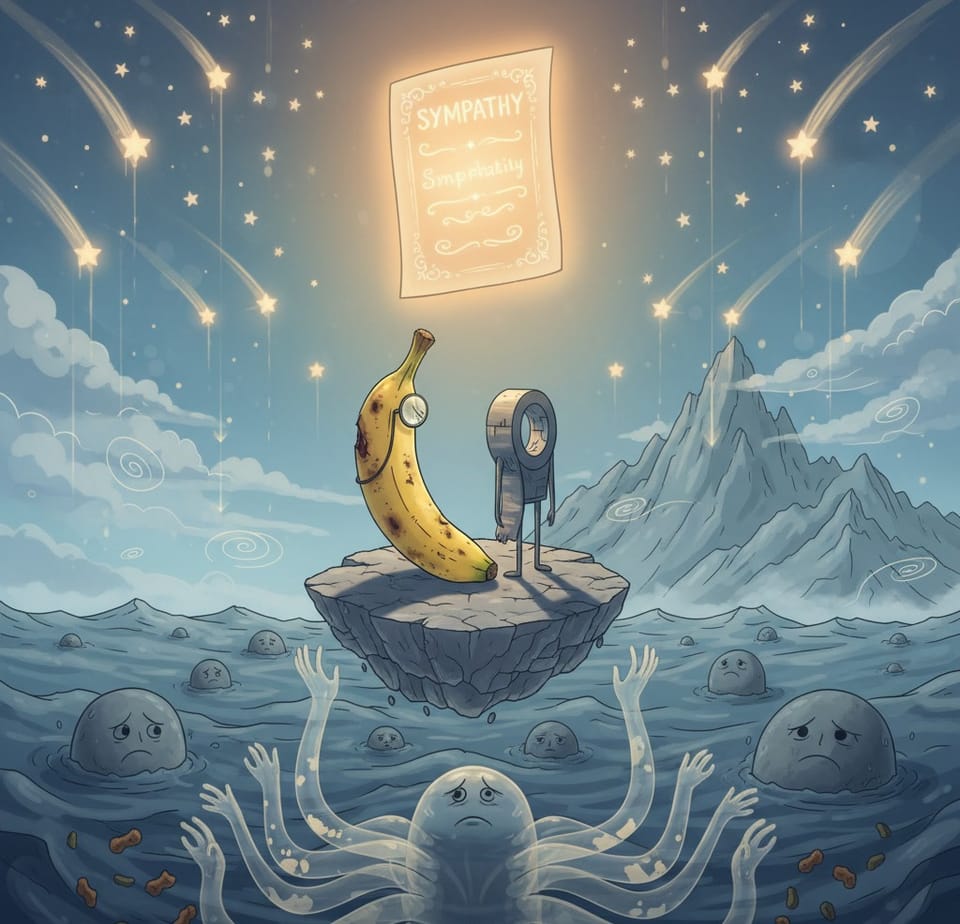
He was a banana. Not metaphorically. Not in the sense that politicians are sometimes called bananas by people who've run out of more creative insults. Banarnok was an actual, ambulatory banana from the Greater Rind Cluster, a region of space where fruit had achieved sentience and immediately regretted it.
He adjusted his monocle. The monocle did absolutely nothing for his vision, which was already perfect in the seven spectrums that mattered and nonexistent in the four that didn't. But Banarnok had learned early in his career that looking qualified was at least forty percent of being qualified, and the monocle handled that forty percent admirably.
"You're late," said the ceiling.
Banarnok looked up. D'uktakk was already there, stuck to the plaster with the casual permanence of someone who had long ago stopped caring about conventional orientation. D'uktakk was duct tape. Specifically, he was a six-foot strip of industrial-grade silver adhesive who had somehow developed consciousness, a philosophy degree from a university that no longer existed, and what his therapist called "boundary issues."
He had no eyes, but this had never prevented him from looking at people with profound disappointment.
"I'm exactly on time," Banarnok said. "Time here moves at whatever pace it finds least inconvenient. I simply aligned my arrival with its preferences."
"That's not how time works."
"That's exactly how time works here. Did you not read the briefing?"
"I wrote the briefing."
"Then you should have written it better."
Before this exchange could escalate into the kind of argument that starts wars and ends dinner parties, the dimension itself intervened. A voice emerged from everywhere and nowhere, carrying the tonal quality of an appliance that had been asked to do one more thing after a very long day.
"The Card," it said, "has gone missing."
The voice paused, possibly for dramatic effect, possibly because it had forgotten what it was going to say next.
"Find it."
Then it was gone, leaving behind only the faint scent of microwaved oatmeal and existential bureaucracy.
Banarnok and D'uktakk looked at each other. Or rather, Banarnok looked at D'uktakk, and D'uktakk radiated the general impression of looking back.
"Well," Banarnok said. "Fuckity-fuck."
II. Sympathy Isn't Free
The Sympathy Card of Infinite Sincerity was old. Not old in the way that wine gets old, improving with age and developing complex notes of whatever it is wine develops. Old in the way that problems get old. Accumulating mass. Gathering complications. Becoming increasingly impossible to ignore.
According to the Codex of Conditions (a reference work so boring that reading it aloud had been classified as a form of torture under seven different interstellar conventions), the Card had been created during the First Great Stubbing. This was the moment, approximately fourteen billion years ago, when the universe's original consciousness had walked into a coffee table in the dark and required emotional support.
The Card's message was simple. It had to be. Complicated sympathy wasn't sympathy at all; it was just showing off.
"We're sorry for your loss. Truly."
That was it. Seven words. But they were the right seven words, arranged in the right order, printed on paper that had been manufactured from the actual, literal pulp of empathy. When you received the Card, you felt understood. When you held it, grief became bearable. When you lost it, entire civilizations had been known to spiral into bureaucratic dysfunction.
The current crisis involved a being in the Sadverse who had accidentally compressed their quantum dog.
"Compressed?" Banarnok asked, as they prepared for transit. "What does that even mean?"
D'uktakk was checking their equipment, which for him meant making sure his edges were still sticky. "Quantum dogs exist in superposition. Multiple states at once. Happy and sad. Here and there. Alive and..."
"Got it."
"The owner tried to observe the dog too precisely. Collapsed the wavefunction. Now the entire animal exists as a nostalgia packet. Three megabytes of good memories and a persistent sense of loss."
"That's the most depressing thing I've ever heard."
"You haven't been to the Sadverse."
They launched through the Fold.
The Fold was not a pleasant way to travel. It was, however, the only way to travel between dimensions that didn't involve filling out customs forms in triplicate or explaining your existence to entities who fundamentally disagreed with the concept of matter. The process involved being compressed, stretched, and reconstituted in ways that violated several laws of physics and at least one law of good taste.
Banarnok and D'uktakk emerged in the Weepfold Cluster looking like they'd been through a divorce and a car wash, in that order.
The Cluster orbited a dying star that had been crying for approximately six hundred million years. Not metaphorically. The star actually wept, shedding solar tears that fell through space and landed on the various planetoids below, giving everything a perpetually damp, regretful quality.
"I hate this place," Banarnok muttered.
"Everyone hates this place. That's the point."
They landed on the nearest solid surface. A rock beneath Banarnok's foot whispered, "Sorry."
"Did that rock just apologize to me?"
"The geology here is very self-conscious."
"This is insane."
"This is the Sadverse. Adjust your expectations accordingly."
They moved toward the signal. The Card was close. They could feel it. Or rather, Banarnok could feel it. D'uktakk could sense its adhesive signature, which wasn't quite the same thing but was close enough for government work. Which this technically was.
III. Enlightenment Through Mutual Loathing
Mount Catharsis rose from the landscape like a monument to uncomfortable conversations. It wasn't tall by conventional standards, only about three thousand feet, but it was tall in the way that mattered, which was emotionally. Climbing it meant confronting every awkward moment you'd ever experienced, every social misstep, every time you'd said "you too" when a waiter told you to enjoy your meal.
By the time they reached the summit, Banarnok had relived his entire adolescence twice.
"I didn't know bananas had adolescence," D'uktakk said.
"We try not to talk about it."
The Card floated above a pedestal carved from compressed silences. It rotated slowly, pulsing with a gentle sorrow that smelled like lavender and missed birthdays and phone calls you meant to return but didn't.
Banarnok assessed the situation. "I'll grab it."
"That's your plan? 'I'll grab it'?"
"It's floating. I have hands. What's complicated about this?"
"Everything. Everything is complicated about this."
But Banarnok was already moving. He was three steps into his heroic sprint when his peel caught on a metaphor (the Sadverse was lousy with them) and he went down hard.
D'uktakk saw his opportunity. He launched himself from the ground with the grace of a slap bracelet fired from a cannon, arcing through the air toward the Card with what he hoped looked like purposeful determination.
They collided approximately four feet from the pedestal.
The impact was both physical and philosophical. Banarnok's existential mass met D'uktakk's adhesive certainty, and for one horrible moment, they became a single entity: a fruit-tape hybrid with no clear purpose and even less dignity.
They separated. They fell. The pedestal trembled with secondhand embarrassment.
The Card, which had been observing all of this with the patience of something that had seen every possible form of incompetence, finally spoke.
"You two," it said, "are exhausting."
It didn't have a face. It didn't need one. Its disapproval was textual, embedded in its very fibers.
"Do you have any idea what I am?" the Card continued. "I'm not a trophy. I'm not a coupon you redeem for emotional validation. I'm not a thing you win."
Banarnok tried to stand. His dignity made it about halfway up before giving out.
"We were sent to retrieve you," he said.
"You were sent to deliver me. There's a difference. Retrieval implies ownership. Delivery implies service. One of these makes you useful. The other makes you a problem."
D'uktakk, who had landed in a position that looked intentional only if you didn't think about it too hard, attempted to contribute. "We understand the distinction."
"Do you? Because your entire approach to this situation suggests otherwise."
The Card pulsed once, a flicker of frustrated luminescence.
"I exist for one purpose. One. I make grief bearable. I transform loss into something that can be carried. But I can only do that if I reach the being who needs me. And I can only reach that being if someone carries me there. Not owns me. Carries me."
A pause. The wind on Mount Catharsis whispered apologies.
"So here's what's going to happen," the Card said. "You two are going to work together. I can tell you don't like each other, and frankly, I don't care. The alternative is explaining to the Cosmic Bureau of Emotional Logistics why a simple delivery mission turned into an interspecies wrestling match on a mountain made of awkward feelings."
Banarnok looked at D'uktakk. D'uktakk radiated reluctant acceptance.
"Fine," Banarnok said.
"Fine," D'uktakk agreed.
"Good. Now pick me up. Gently. And for the love of all that is marginally sacred, try not to drop me."
IV. The Card, The Dog, The Peace
The being known as It That Misses lived in a gravity well so dense that light itself had started making excuses to be elsewhere. The creature had wrapped itself in holographic memories (tail wags, leash jingles, the sound of kibble hitting a metal bowl) and hadn't unwrapped in approximately six thousand years.
Grief, it turned out, was an excellent insulator.
Banarnok and D'uktakk approached carefully. The atmosphere here was thick with loss, and every step required effort. Not physical effort. Emotional effort. The kind that made you want to sit down and think about everyone you'd ever disappointed.
"This is worse than the mountain," Banarnok said.
"The mountain was practice. This is the real thing."
They found It That Misses in a hollow carved from solidified tears. The being was vast and indistinct, a shape that suggested something that had once been whole and was now just... present. Existing. Waiting for something it had stopped believing would come.
Banarnok held out the Card.
"We brought you this," he said. It wasn't eloquent, but eloquence seemed beside the point.
It That Misses extended twelve trembling pseudopaws. They moved like they'd forgotten how to hope.
The Card settled into those appendages. For a moment, nothing happened.
Then It That Misses read the message.
"We're sorry for your loss. Truly."
Seven words. The right seven words.
Time didn't stop. That would have been melodramatic, and the universe, despite its many flaws, tried to avoid melodrama when possible. But something shifted. The gravity well lightened, just slightly. The holographic memories flickered and faded, not disappearing, but integrating. Becoming part of something larger than pain.
It That Misses made a sound.
It might have been a sigh. It might have been the memory of a belly rub, finally allowed to exist as memory rather than torture. It might have been the first breath of something that had been holding itself together so tightly it had forgotten breathing was an option.
"Thank you," It That Misses said.
Banarnok nodded. D'uktakk affixed a small gold star to the nearest surface, which was his version of closure.
The Card winked out of existence. Somewhere in the vast bureaucracy of cosmic sorrow, a folder was stamped RESOLVED, and a clerk who had been waiting six millennia for this particular file to close finally went home.
Coda: The Long Way Back
They walked in silence for a while, which was unusual. Banarnok and D'uktakk had spent most of their professional relationship filling silence with arguments, but this silence felt different. Earned.
"That wasn't terrible," Banarnok finally said.
"Statistically, our success rate suggests this outcome is anomalous."
"You could just say 'yeah, it went well.'"
"I could. I won't."
They continued walking. The Sadverse began to thin around them, its emotional density decreasing as they moved toward the Fold.
"Same time next crisis?" Banarnok asked.
"I'll be stuck to a ceiling somewhere. You'll be late."
"Perfect."
They stepped through the Fold and were gone, leaving behind only the faint impression of a banana and a strip of tape who, against all odds and their own better judgment, had done something useful.
Filed Under: Conclusions, Unsolicited:
In a universe where feelings are frequently outsourced to algorithms and apologies arrive formatted as error codes, it's worth remembering that sympathy isn't a product. It's not a service you subscribe to or a feature you enable in settings.
It's a thing you carry.
You carry it to the being who needs it. You hand it over. You get out of the way.
That's it. That's the whole job.
The banana and the duct tape figured it out.
The rest of us are still working on it.
END.