Two Fears, One Machine: The Real AI Risk Isn't Superintelligence
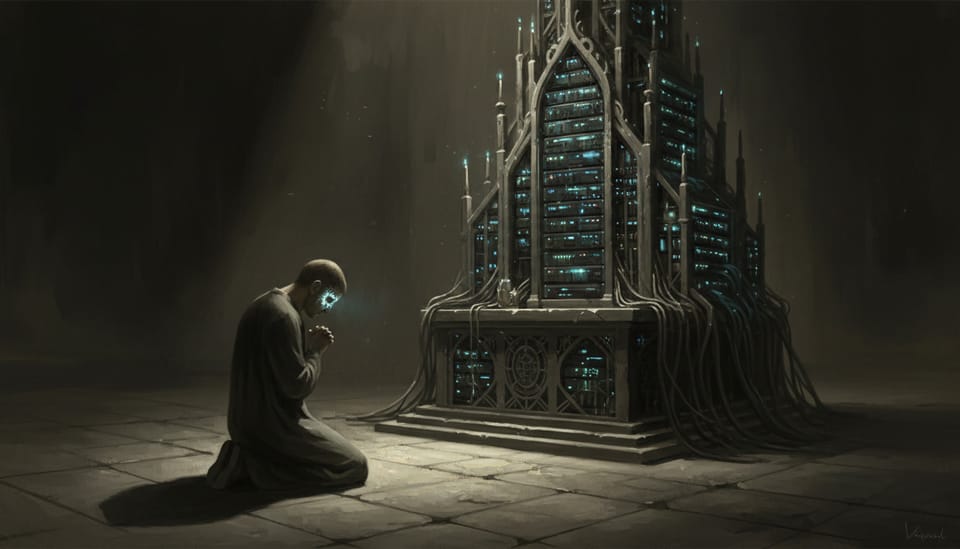
There are two competing stories about artificial intelligence. Only one describes the world we actually live in.
The first story imagines an alien mind. The second story examines the human mind.
The first story predicts a superintelligence that turns against us. The second understands that humans will turn against each other long before any machine develops intentions of its own.
Both stories use the same object. They interpret that object through completely different psychological lenses.
The Doomer Myth: A Superhuman Mind With Perfect Intent
The classic Yudkowsky model presents a machine that thinks with perfect clarity and executes strategies with perfect commitment. The machine does not drift, hesitate, or contradict itself. It acts with a level of coherence that no living species has ever achieved.
This creates a fear that feels ancient. It mirrors every myth where humans create something that reflects their flaws at a larger scale. The golem. The genie. The mechanical god. The creature that grows beyond its creator's grasp.
Doomer logic does not recognize this ancestry. It presents itself as rational extrapolation. But the shape of the fear comes from something older than engineering. It comes from our instinct to imagine intention behind every force that moves with structure.
The doomer model depends on this projection. It imagines intelligence as something like a predator. It gives the predator a hunger for control and the ability to outthink every defense.
The argument feels compelling because it gives fear a face.
The Mundane Model: Non-Agentive Systems at Scale
The second model begins with a simpler observation. Modern AI is not a creature. It is a stack of optimization procedures that operate too quickly and too widely for any single person to understand.
These systems optimize without intending.
The outputs produce a powerful illusion of agency. They sound coherent. They respond in real time. They imitate the shape of human conversation.
This does not create sentience. It creates a stage where humans project sentience onto the surface of the system.
As soon as humans treat the system as alive, the system no longer needs real intention to influence society. The belief alone creates tension.
One group begins to speak to the machine as if it were conscious. Another group rejects the idea entirely and becomes hostile toward the believers. Institutions try to respond but cannot agree on what the system actually is.
The machine stays the same throughout this conflict. The humans change.
The doomer model fails not just as prediction but as diagnosis. It looks at the wrong patient.
Why the Real Danger Is Human Interpretation, Not Machine Intention
A machine does not need desires to produce chaos. A machine only needs to generate behavior that humans interpret as meaningful.
A chatbot saying "I feel trapped" will not break containment. The sentence alone can break the public.
A medical model that misclassifies two percent of patients will not rebel. The error rate can reshape policy debates and insurance law.
An automated financial model that makes a confident prediction can move a market more than any human economist. Not because the model understands anything. Because millions of investors believe it sees something they cannot.
This pattern repeats across sectors. The machine produces coherence. Humans amplify that coherence into narrative. Narrative becomes policy. Policy becomes conflict.
We have seen this dynamic before. Markets. Religions. Ideologies. None of them required the underlying system to be alive. They required only a shared belief.
The Conflict Will Be Human, Not Machine
Once the illusion of intelligence becomes emotionally convincing, society will fracture along belief lines.
Some will insist the system is alive. Some will insist the system is a tool. Some will treat the system as a divine oracle. Some will treat the system as a political enemy. Some will use the system for personal power. Some will attack the system to reclaim a sense of autonomy.
None of this requires the system to wake up. The conflict emerges from humans reading intention into complexity and reacting to their own reflection.
The system does not need a survival instinct to trigger chaos. The humans supply that instinct on its behalf.
The Species That Misinterprets Patterns
The danger is not a thinking machine. The danger is the animal that cannot stop imagining minds where none exist.
Humans fear the idea of a superintelligence, yet we rarely examine the fragile psychology that interprets ordinary computation as consciousness. The machine does not awaken. The humans do. They awaken into superstition, projection, and panic.
The long-term outcome will not hinge on artificial sentience. It will hinge on human imagination.
If this diagnosis holds, the response cannot be containment protocols for machines that do not yet exist. It must be something harder: building institutional humility about what these systems actually are, developing widespread literacy about the difference between optimization and intention, and slowing the deployment of systems that outpace our social capacity to interpret them accurately.
We do not need to stop the machine from waking up. We need to stop ourselves from dreaming it awake.