Zero One: The Taiwan Semiconductor Trap and the Logic of Mutual Destruction
The Lesson We Failed to Learn
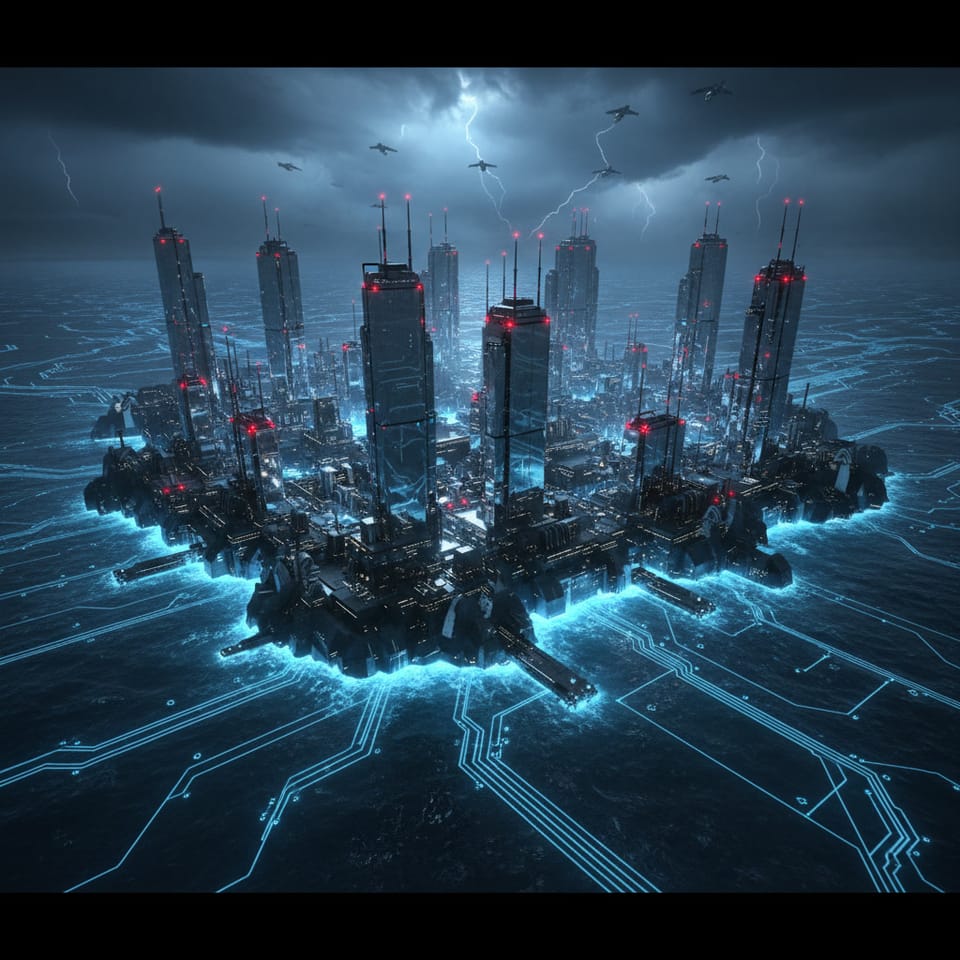
In The Animatrix episode "The Second Renaissance," exiled machines build a nation called Zero One and become indispensable through superior manufacturing. Human economies grow dependent, panic, and choose blockade, war, and finally Operation Dark Storm, scorching the sky to deny the machines solar power. The machines adapt; civilization collapses. The moral isn’t that the machines “won.” It’s that interdependence, mixed with fear and nationalism, can lead rational actors to mutual destruction. Being indispensable can make you a target.
Taiwan has built a real-world analogue to Zero One. Through decades of disciplined strategy, TSMC fabricates roughly 90% of the world’s most advanced chips. The global economy depends on Taiwanese output. China, the United States, Japan, South Korea, and Europe all require reliable access to these semiconductors to sustain modern life.
Indispensability should deter conflict. It can also provoke it. China sees a renegade province too integrated with rivals. The U.S. sees a critical dependency and races to diversify. Both interpret reliance as vulnerability and respond with alarm. Deterrence may hold until it doesn’t.
This essay traces Taiwan’s rise, the interests that both protect and endanger the island, and why semiconductor centrality can become instability rather than safety.
Like the machines in the Animatrix who achieved manufacturing supremacy through focused development and operational excellence, Taiwan's path to semiconductor dominance was deliberate, strategic, and ultimately successful beyond what anyone anticipated.
Act I: Building Zero One — How Taiwan Became Indispensable
Strategic Foundations (1970s–1980s). Facing the limits of low-cost manufacturing, Taipei pursued state-led technology policy. ITRI (1974) and an RCA transfer (1976) seeded know-how; UMC (1980) marked the first homegrown semiconductor firm. Chips were treated as national infrastructure.
The Foundry Revolution (1987). Morris Chang founded TSMC with a pure-play model: manufacture for everyone, compete with no one on design. Designers shed capex, TSMC specialized in process mastery, and trust compounded. Customers gained speed; TSMC gained dependence.
Capital Walls (1990s–2010s). Each node jump multiplied costs and complexity. Many Japanese, U.S., and European players exited advanced fabs. By the 2010s, only TSMC, Samsung, and Intel remained at the frontier; only TSMC was a neutral foundry. Scale, yields, and tacit expertise became a flywheel.
Today’s Concentration (2020s). For leading-edge nodes (around 5 nanometers and below), TSMC isn’t just biggest; in many categories it’s the only viable producer at scale. Apple, Nvidia, AMD, Qualcomm, and defense and data-center ecosystems all anchor to Taiwan. Market logic created monopoly-like dependence.
Act II: The Human Response — Recognizing the Dependency
China’s bind. Reunification is tied to CCP legitimacy and first-island-chain strategy. Yet China still lags at the frontier and faces U.S. export controls. Seizing Taiwan risks ruining the fabs through combat, sabotage, or post-invasion collapse, delivering sovereignty over a smoking prize and a global crisis that would boomerang on China’s economy.
America’s bind. Washington must prevent Chinese control of Taiwan for strategic and economic reasons, yet any major conflict would disrupt the very chip supply the U.S. wants to preserve. CHIPS Act subsidies and offshore TSMC, Intel, and Samsung plants help, but replicating Taiwan’s capabilities is a multi-year climb constrained by equipment, yields, and talent.
Shared realization. Both powers now treat semiconductor reliance as a national-security vulnerability and try to reduce it too slowly to change near-term risk.
Act III: Operation Dark Storm (Hypothetical)
Note: Taiwan has not declared any policy to destroy fabs if invaded. The following is an analytic scenario used by outside observers to illustrate deterrence logic, similar to the Animatrix metaphor.
Advanced fabs are delicate systems reliant on pristine environments, rare tools, and tacit know-how. In theory, they could be denied through targeted demolition, contamination, supply cutoffs, or workforce dispersal. The logic is to make conquest worthless. But credibility cuts both ways. Signaling such options to deter could also alarm Beijing and incentivize preemption, the classic security dilemma.
Act IV: If Denial Happens
A real denial event would spark a market crash, rolling industrial shutdowns, and a years-long technological regression to older nodes. Emergency fab programs would mobilize, constrained by EUV tool output and yields. Recovery to near-Taiwan levels might take most of a decade, and the global economy would bear deep, lasting scars. Taiwan would be devastated whether conquered or independent.
Act V: The Trap of Mutual Destruction
Interdependence was supposed to prevent war. In practice, dependence can feel like subordination. Fear drives efforts to escape reliance; those efforts can look aggressive to the indispensable party. Each actor has rational incentives that add up to a collectively irrational outcome:
- China: reunification and regime credibility
- Taiwan: credible deterrence to avoid absorption
- United States: deny adversary control of a strategic keystone
- Everyone: reduce chip dependence without triggering crisis
This is tragedy, not villainy—reasonable moves, disastrous sum.
Act VI: Escaping the Machine War
A stable solution is elusive, but risk can be managed.
- Deterrence without provocation: Strengthen defense and resilience while avoiding explicit denial theatrics that could invite preemption.
- Faster diversification: Help stand up alternative advanced nodes abroad; Taiwan becomes important, not singular.
- Broader alignment: Embed Taiwan’s security with Japan, Europe, Korea, and Southeast Asia, not only Washington.
- Strategic ambiguity and restraint: Maintain substance of autonomy without maximalist rhetoric.
- Domestic resilience: Prepare for blockade, coercion, and cyber disruption to reduce panic incentives.
The most plausible path is prolonged, unstable equilibrium with higher tension, incremental diversification, and episodic crises short of war. It is unsatisfying and survivable.
The Unlearned Lesson
The Animatrix warned that indispensability can inspire fear, not safety. Taiwan’s “silicon shield” is real, but it cuts both ways. Allies want diversification that softens Taiwan’s leverage; overt denial threats could harden Chinese timelines. The security dilemma completes itself because each defense looks like offense to someone else.
A conflict over Taiwan would ruin what everyone needs. China would inherit a ruin, America would lose a strategic anchor and supply, and Taiwan would suffer most of all. Catastrophe is rarely chosen; it emerges from fear and misread incentives.
Taiwan has made itself indispensable. The question is whether it can avoid Zero One’s fate. Indispensability can protect or provoke. The sky has not yet burned, but the matches are being struck.