The Emotional Support Protagonist
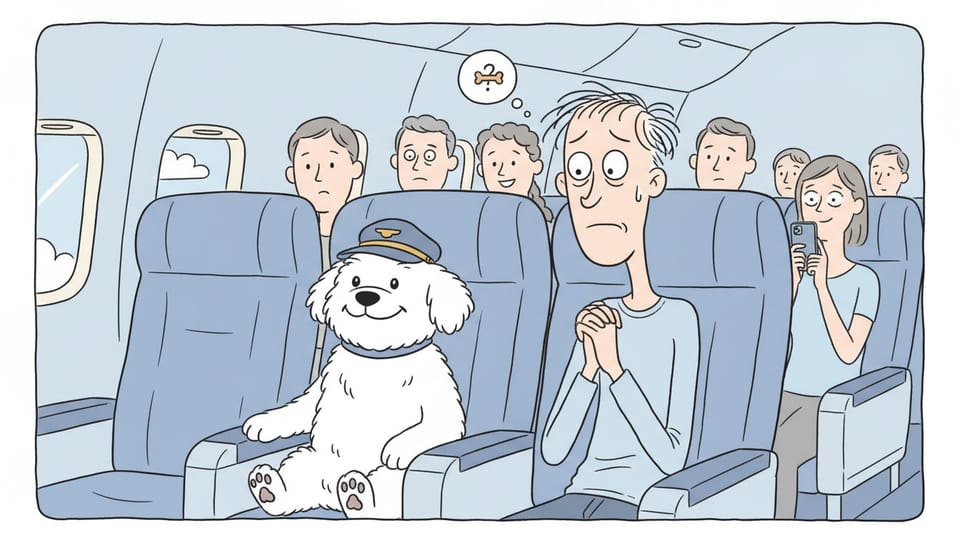
Today we are talking about the new species that only appears in metal tubes at cruising altitude.
The Emotional Support Protagonist.
They are not harmful.
They are not dangerous.
They are simply… a lot.
Like a human glitter bomb who brought a dog to do spiritual labor on a plane that already smells like reheated noodles and mild regret.
Let us begin.
The Moment They Board, the Dog Becomes a Toddler
You can spot an Emotional Support Protagonist before they reach row nine. The dog is tucked into their arms like an heir to a small kingdom. The owner speaks softly in full preschool-parent cadence.
“You are so brave. You are doing amazing. Mommy loves your courage.”
The dog blinks. It does not know what courage is. It only knows a loud sky machine is happening and it was happier at home next to a window.
But the owner continues, narrating the entire boarding process to the dog like a nature documentary filmed for one exceptionally bewildered audience member.
The Crew Becomes Therapists
Once seated, the flight attendants are pulled into the emotional gravity well.
“Could we get some water for him? Room temperature. He is sensitive.”
“Do you have a blanket? Nothing scratchy. He has boundaries.”
“We might need to sit near the aisle. He gets existential when he cannot see light.”
The crew handles it with grace because they have seen everything. People fainting. People arguing. People trying to microwave pocket snacks. One dog with a sweater barely registers as a complication.
Still, the dynamic is unmistakable.
The dog is not the needy party.
The dog is the stabilizer for the human who is quietly losing the plot.
Everything the owner asks is actually a coded message.
“My anxiety is rising. Please adjust the universe.”
The Consequences Become a Group Project
Eventually the dog does what dogs do.
A small bark at nothing.
A puff of dander.
A decisive smell.
A tiny tremble that shakes more fur loose than seems biologically possible.
This is the moment the Emotional Support Protagonist becomes fully activated.
They offer the cabin a polite smile that says:
“He is doing his best. So are you.”
There is no malice in it.
Just the gentle assurance that everyone intuitively understands the life cycle of anxiety management at 35,000 feet.
Whether or not anyone actually does is irrelevant.
Awareness Takes a Vacation Somewhere with More Oxygen
Airplanes are famously compact.
Everything touches something else.
No one can retreat.
The concept of personal space has been replaced by shared survival.
But the Emotional Support Protagonist forgets this. They talk to the dog in a soft, theatrical tone that carries three rows forward. They adjust their seat. They shift the dog. They forget other humans exist because all attention funnels into one singular mission.
Keep the dog calm so the human stays upright.
The rest of the cabin quietly practices social restraint, the one muscle that gets the most exercise in modern life.
The Inescapable Mess
Occasionally, nature exercises its veto power.
Stress wins.
The dog folds.
Gravity collaborates.
A smell arrives.
A silence follows.
A flight attendant closes their eyes for two full seconds.
The owner looks apologetic and relieved. The dog looks spiritually liberated. The cabin looks like it wants a fresh start in a new life.
It is not anxiety.
It is not trauma.
It is not disability.
It is simply adulthood performed with assistance.
The Soft Truth Beneath the Humor
Most Emotional Support Protagonists are not villains. They are overwhelmed people clutching the one thing that brings them back to Earth while hurtling through the sky.
Under other circumstances, it might be endearing.
It is just that airplanes are the least forgiving place to witness emotional regression. There is no escape. No fresh air. No pause button.
Just recycled oxygen, a soft whimpering dog, and a human trying their best not to unravel.
We laugh because the alternative is reenacting a tense BBC documentary about societal collapse inside row fourteen.
The Mile High Moral of the Story
Maybe airlines will one day designate a special section for this entire archetype. Rows where dogs get snacks first. Rows where humans are encouraged to narrate turbulence like a bedtime story. Rows where flight attendants carry emotional support spray bottles for when things get too real.
Until then, we buckle in, breathe deeply, and accept that sky travel is the only activity where strangers become temporary family and at least one of them is carrying a chihuahua who knows too much.