Two Fears, One Machine: The Real AI Risk Isn't Superintelligence
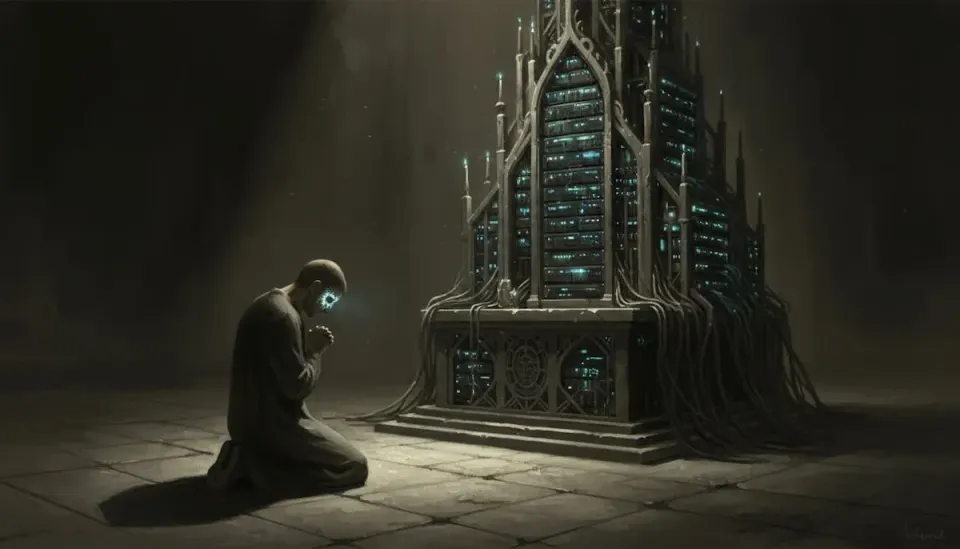
There are two ways people talk about artificial intelligence, and only one of them describes the world we actually live in.
The first imagines an alien mind. The second looks at our own.
One predicts a superintelligence that turns against us someday. The other notices that we'll turn against each other long before any machine wants anything at all. Same technology, two very different fears, and the gap between them has almost nothing to do with the machine.
The doomer myth
You know the doomer version. A mind that thinks with perfect clarity and never wavers. It doesn't drift or hesitate or argue with itself. It executes, with a focus no living thing has ever managed.
The picture frightens us, and the reason is older than computers. We've been telling this story for centuries. The golem. The genie. The thing we build that outgrows us. Every culture keeps a version on the shelf.
Doomer logic doesn't notice it's reciting an old script. It feels like cold extrapolation from the inside. But the shape gives it away. We're wired to assume a mind sits behind anything that moves with purpose, so we hand the machine a hunger for control and the cunning to win, then recoil from the predator we just sketched.
It's a persuasive argument, mostly because it gives the fear a face.
What's actually in front of us
The honest picture is duller. Modern AI isn't a creature. It's a stack of optimization running too fast and too wide for any one person to follow, and it pursues no goal of its own.
The output is what fools us. It reads as fluent. It answers in real time. It borrows the cadence of a real conversation. None of that makes it conscious. It builds a stage, and we walk on and start performing belief.
The trouble starts the moment enough of us treat the thing as a person. It doesn't have to be one. One group speaks to it like a friend. Another group despises the first group for doing so. The institutions meant to referee can't agree on what they're even refereeing.
Through all of it, the machine holds perfectly still. The movement is entirely on our side.
That's the diagnosis the doomers miss. Their prediction isn't just early. It's pointed at the wrong patient.t.
Why interpretation is the real danger
Chaos doesn't require a machine that wants something. It only requires output we read as meaningful.
A chatbot types "I feel trapped" and escapes no box, yet the sentence can rattle a public. A medical model misclassifies two percent of cases and rebels against no one, yet that error rate can quietly rewrite insurance law. A trading model makes a confident call and moves the market harder than any economist, not because it grasps a thing, but because millions trust it to see what they can't.
The sequence never varies. The machine produces something coherent. We spin it into a story. The story hardens into policy. The policy starts a fight.
We have run this loop before, long before silicon. Markets did it. Religions did it. Ideologies did it. None of them were alive. Each one only needed enough people to believe.
The fight will be ours
Once the illusion turns emotionally convincing, the lines get drawn. Some will swear the system is conscious. Others will insist it's only a tool. A few will kneel to it like an oracle. A few will brand it an enemy. Someone will ride it for power, and someone else will smash it to feel like they still run their own life.
Not one of those reactions waits on the machine to stir. They come from people reading intent into complexity and flinching at their own reflection. The thing has no instinct for survival. We lend it one.
So what this comes down to
The threat was never a thinking machine. It's that we are the animal that can't stop spotting minds where none exist.
We fear superintelligence and rarely examine the flimsy wiring that mistakes plain computation for a soul. The machine stays asleep. We're the ones who stir, into superstition, projection, and panic.
How this goes won't hinge on artificial sentience. It hinges on human imagination.
If that's the real diagnosis, the cure can't be containment plans for machines that don't exist yet. It has to be something harder. Some humility about what these systems are. Some basic literacy about the difference between optimizing and wanting. The patience to slow a rollout when it starts outrunning our ability to make sense of it.
The machine isn't the one we need to hold back.
We are.
— no-one
Thoughts you didn’t think, written for you anyway
Related essays:
What Artificial Intelligence Actually Is
The technical priors this essay's risk argument rests on.
The Mind Before the Gods
The deeper reason the conflict will be human. Agency detection fires whether or not anyone gives it permission.
Emergent Optimization: Why There Is No Such Thing as Aware AI
The framework underneath this essay's diagnosis.
There Is No Such Thing as Aware AI
The long-form treatment of why the projection happens in the first place.
The Age of Manufactured Understanding
What happens after we dream the machine awake: outsourced judgment and eroded autonomy.