What Artificial Intelligence Actually Is: A grounded explainer
The Plain Definition
Artificial intelligence is software that performs tasks normally associated with human cognition. Recognizing speech. Translating language. Identifying images. Solving problems. Making predictions. Generating text.
The term covers a wide range of techniques, most of which share one underlying mechanism. The system takes in data, processes it through a set of mathematical operations, and produces an output. The operations are tuned through a process called training, where the system adjusts itself until its outputs match the desired result more often than not.
Nothing inside the system understands what it is doing. The system has no goals, no preferences, no awareness of the task. It has parameters that have been shaped by exposure to data, and it produces outputs that follow from those parameters when new inputs arrive.
That is the entire mechanism. Everything else is a question of scale, architecture, and application.
The Term Itself
The phrase "artificial intelligence" was coined in 1956 by John McCarthy, an assistant professor of mathematics at Dartmouth, in a proposal he co-authored with Marvin Minsky of Harvard, Nathaniel Rochester of IBM, and Claude Shannon of Bell Labs. The four were planning a summer workshop to bring researchers together around a new field, and they needed a name for it.
The reason McCarthy picked "artificial intelligence" was specific. He wanted to escape association with cybernetics, the existing field most closely related to the group's work, and to keep its dominant figure Norbert Wiener at a distance. In his own words: "One of the reasons for inventing the term artificial intelligence was to escape association with cybernetics. Its concentration on analog feedback seemed misguided, and I wished to avoid having either to accept Norbert Wiener as a guru or having to argue with him."
The workshop proposal stated that the project would proceed on the basis "that every aspect of learning or any other feature of intelligence can in principle be so precisely described that a machine can be made to simulate it." The framing was ambitious by design. McCarthy and his collaborators wanted to claim ground for a new discipline, and the word "intelligence" did that work.
The choice has shaped the field ever since.
What the Phrase Implies
"Artificial intelligence" is a two-word phrase that carries a hidden argument. The word "intelligence" presumes that what the machine produces is comparable to what minds produce. The word "artificial" presumes that the comparison is meaningful but qualified, that the machine version is a manufactured equivalent rather than a true one.
Both presumptions are doing work before any actual technology is described. Once you accept the phrase, you have already accepted that there is a real category called intelligence, that humans have it, that machines can produce a version of it, and that the difference between the two is one of origin rather than kind.
None of those claims were established by the technology. They were embedded in the name.
Alternative Names That Were Considered
Other terms were proposed at the time and afterward. "Cybernetics," coined by Norbert Wiener in 1948, described the study of control and communication in animals and machines. The word came from the Greek for "steersman" and emphasized feedback and regulation. The term described what the early systems actually did more accurately than "intelligence" did. It lost ground to "artificial intelligence" largely because McCarthy preferred a different research direction, one focused on symbolic reasoning and logic rather than the analog feedback that cybernetics emphasized. The institutional separation from Wiener was the other major factor.
"Complex information processing" was used by Herbert Simon and Allen Newell, two of the field's founders, who preferred a more technical and modest framing. The phrase did not catch on, again for reasons of momentum and marketing.
"Machine learning" emerged later as a narrower technical term, but it sits inside the broader AI umbrella in public usage.
The point is that the field could have been named differently, and the names that lost would have shaped public perception in other directions. A discipline called complex information processing would not carry the same cultural anxieties as one called artificial intelligence.
Why the Naming Matters
The phrase "artificial intelligence" predisposes the listener to compare machines to minds. Every subsequent discussion inherits that frame. When a model performs well on a benchmark, the natural language is to say the machine is intelligent, or approaching intelligence, or surpassing human intelligence. The verb structure assumes a continuum.
If the field had been named "automated optimization" or "scaled pattern processing," the same benchmark results would generate different sentences. The machine optimizes well. The pattern processor handles a wider range of inputs. Neither sentence implies a mind. Both describe what the system actually does.
This is not a complaint about a naming decision made seventy years ago. It is an observation that the language people use to describe these systems was set before anyone knew what the systems would become. The language now shapes what people see in the outputs, and what they see is filtered through a word that was chosen partly for its persuasive power.
The Emergent Optimization frame treats this as part of the perceptual problem it diagnoses. The systems produce outputs that look like mind. The language we inherited to describe them tells us to call that look intelligence. The combination of the appearance and the language locks the misreading in place.
A more honest term for the technology might be something like "engineered optimization." It would describe the mechanism accurately and remove the suggestion that the systems are doing anything cognitive. The phrase "artificial intelligence" will not go away. But naming what the phrase is doing helps explain why the public conversation about these systems keeps returning to questions of consciousness, awareness, and personhood. The questions are baked into the name.
The Two Useful Categories
Public conversation about AI gets cluttered by overlapping labels. The clearest split is between two categories.
Narrow AI
Narrow AI handles one task or a small cluster of related tasks. A spam filter. A recommendation engine. A medical imaging classifier. A chess program. A voice assistant. A fraud detection system.
Every AI system currently in production is narrow AI. Even systems that appear general, like large language models, are narrow in the technical sense. They are optimized for one underlying task, which is predicting the next token in a sequence. The breadth of their apparent capability comes from how much human-generated text they were trained on, not from any general reasoning ability inside the model.
Narrow AI is the entire commercial landscape. Search. Translation. Image generation. Code completion. Customer service. Logistics. Every product marketed as AI today fits inside this category.
General AI
General AI, sometimes called artificial general intelligence or AGI, refers to a hypothetical system that can perform any cognitive task a human can perform, across any domain, without being retrained for each new task.
General AI does not currently exist. Whether it can exist, what it would require, and how close current systems are to producing it are open questions. The companies building large models often describe their work as a path toward AGI. Whether that path leads anywhere is the subject of ongoing debate.
The distinction between narrow and general is the most important one to hold onto. Almost every confusion in public AI discourse comes from treating narrow systems as if they were general, or treating general AI as if it already existed.
The Main Technical Families
Within narrow AI, several technical approaches do most of the work. The lines between them blur in modern systems, but the categories are useful.
Rule-Based Systems
The oldest form. A human writes explicit rules and the system follows them. If condition A is met, take action B. Early expert systems, traditional chess engines, and most older automation tools fit here.
Rule-based systems are transparent and predictable. They are also brittle. They handle situations the rules anticipate and fail when reality deviates. Most of the AI built before 2010 was rule-based or rule-adjacent.
Machine Learning
Instead of writing rules, the developer gives the system examples and lets it derive its own patterns. Show it a million labeled photos of cats and dogs, and it learns to distinguish them. Show it a million emails marked as spam or legitimate, and it learns to filter.
Machine learning systems are more flexible than rule-based ones. They are also less transparent. The patterns the system learns are encoded in numerical weights that humans cannot read directly. This opacity becomes important as systems grow larger.
Deep Learning
A subset of machine learning that uses layered networks loosely inspired by the structure of the brain. These networks, called neural networks, can capture patterns that simpler machine learning methods miss. Image recognition, speech recognition, and language processing all advanced sharply once deep learning became practical around 2012.
Deep learning is responsible for almost every dramatic capability jump in the past decade. It is also where the opacity problem becomes acute. The internal workings of a deep network are even harder to interpret than earlier machine learning systems.
Large Language Models
A specific application of deep learning trained on enormous text datasets. The model learns to predict the next piece of text given what came before. Scaled up, this simple objective produces systems that can write essays, answer questions, generate code, and summarize documents.
Large language models are the technology behind ChatGPT, Claude, Gemini, and similar products. They are narrow AI in the technical sense, but their breadth of apparent capability is what triggers most of the current public confusion about awareness and intelligence.
Reinforcement Learning
A different approach where the system learns by trial and error. It takes actions in an environment, receives rewards or penalties, and adjusts its behavior to maximize reward over time. Game-playing systems like AlphaGo use reinforcement learning. So do many robotics applications and some recommendation systems.
Reinforcement learning is also increasingly used to refine large language models after their initial training, to make their outputs better match human preferences.
Generative Models
Systems that produce new content rather than classifying or predicting. Image generators. Music generators. Text generators. Video generators. Most generative models use deep learning architectures designed to produce outputs that resemble their training data while introducing variation.
Generative AI is the category that has driven most of the recent commercial excitement and most of the public confusion. The outputs look creative. The mechanism is statistical.
The Capability Layer Most People Encounter
Below the technical families sits a layer of products that combine multiple techniques. These are the systems most people actually interact with.
Chatbots and assistants wrap large language models in conversational interfaces. ChatGPT, Claude, and Gemini are the most visible examples.
Agents are language models given the ability to take actions in software environments. They can browse the web, edit files, run code, and chain together sequences of steps without being prompted at each one. Agentic systems are the current frontier of commercial AI development.
Multimodal systems handle more than one type of input or output. Text and images. Text and audio. Text, images, and video. The newer frontier models are increasingly multimodal by default.
Recommendation engines use machine learning to predict what content or products a user will engage with. Social media feeds, streaming platforms, and online retail all rely heavily on these systems.
Computer vision systems identify objects, faces, text, and actions in images and video. Used in security, medical imaging, manufacturing, autonomous vehicles, and content moderation.
Speech systems convert speech to text, text to speech, and increasingly handle full conversational interaction in voice.
The Category Most People Miss
Most public conversation about AI focuses on the systems people interact with directly. Chatbots, image generators, recommendation feeds. These are the visible surface.
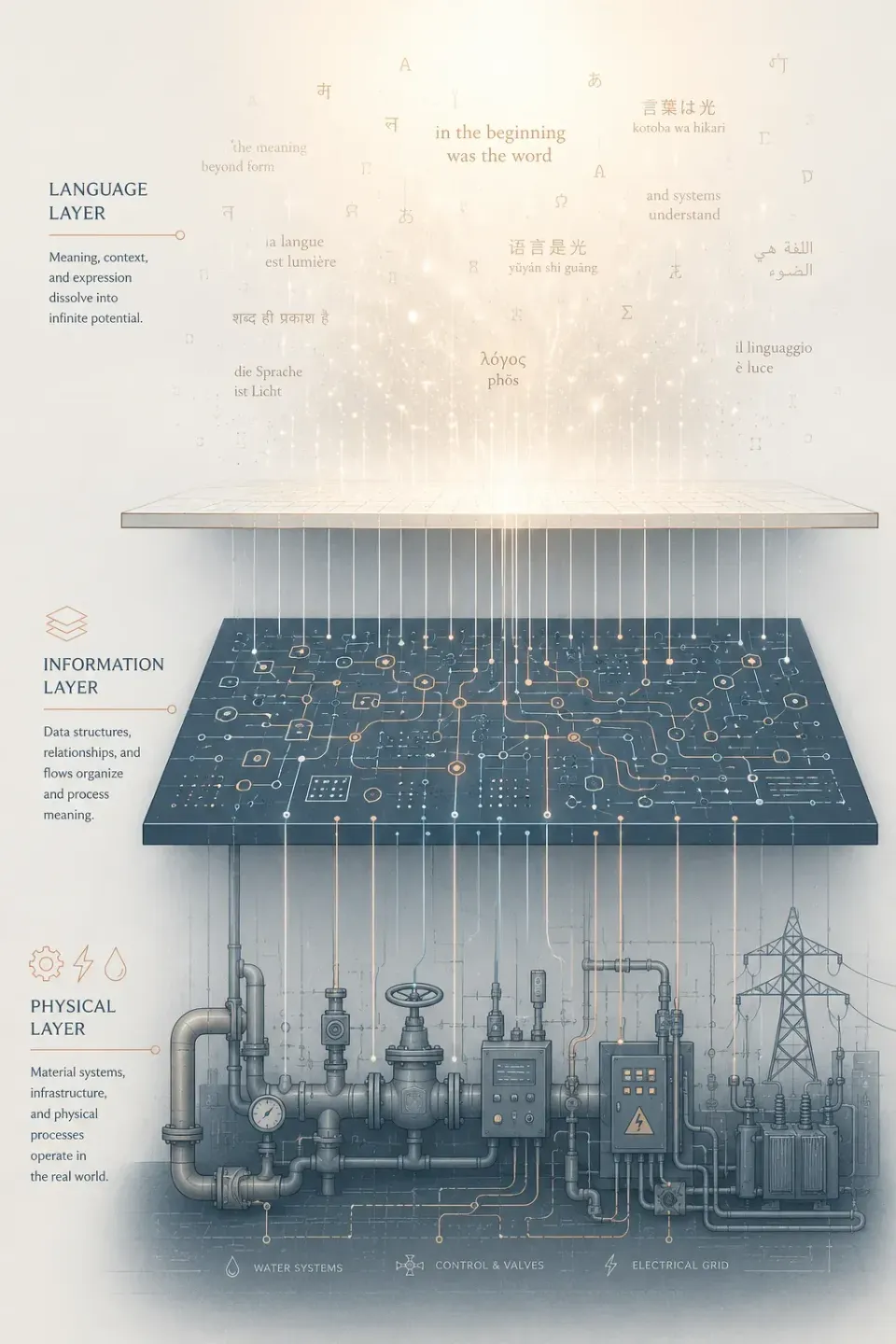
Below that surface sits a much larger and older category. The systems that run infrastructure. Water treatment. Power grids. Traffic networks. Heating and cooling in large buildings. Industrial processes. Logistics and supply chains. Air traffic. Telecommunications routing.
These systems rarely get called AI in marketing copy. They predate the current excitement by decades. But they are the clearest real-world examples of the mechanism described here, and they shape daily life more than any chatbot does.
Control Systems and Industrial Automation
The oldest layer. A sensor measures something. A controller compares the measurement to a target. An actuator adjusts the system to close the gap. A thermostat is the simplest version. A modern power plant runs thousands of these loops at once, coordinated through software that balances variables in real time.
Control systems do not learn in the machine learning sense. They follow engineered rules and feedback loops. What makes them feel intelligent is the density of coordination. A water treatment plant adjusts chemical dosing, flow rates, filtration cycles, and storage levels continuously, responding to changes in demand, weather, and source water quality. No single operator could track all of it manually. The system handles it because the loops were designed to handle it.
SCADA and Distributed Architecture
SCADA stands for Supervisory Control and Data Acquisition. It is the software layer that lets human operators monitor and adjust large distributed systems. Power grids, pipelines, rail networks, and municipal utilities all run on SCADA-class systems.
Most large infrastructure runs on a distributed architecture. Decisions are made across many local controllers rather than from a single central computer. A regional power grid balances supply and demand across thousands of nodes, each adjusting locally while the whole system maintains stability. When part of the grid fails, the surrounding nodes reroute automatically. The coordination comes from how the system was engineered, not from any node knowing what the grid is.
Adaptive Traffic Systems
Modern urban traffic networks use sensors at intersections, cameras along corridors, and increasingly data from vehicles themselves to adjust signal timing in real time. Some systems use machine learning to predict congestion patterns and optimize flow across entire grids. Others use simpler feedback rules that still produce adaptive behavior at scale.
The result is a city-wide system that reroutes traffic, smooths flow, and recovers from disruptions without any central mind directing it. Each intersection makes local adjustments. The pattern of those adjustments aggregates into something that looks like the city itself is thinking. It is not. The thinking happened during the design phase, and the system executes.
Building Management Systems
Large commercial and institutional buildings run on integrated software that controls heating, cooling, ventilation, lighting, elevators, security, and energy use. The systems learn occupancy patterns, anticipate demand, and adjust pre-emptively. A hospital, a stadium, or a data center operates on this kind of integrated control at a scale that would be impossible to manage manually.
These systems increasingly use machine learning to improve their predictions, but the core logic is feedback-driven optimization across many variables at once. The visible result is a building that feels responsive, comfortable, and efficient. The mechanism is engineering, not awareness.
Logistics and Supply Chain Systems
Global shipping, warehousing, and delivery now run on optimization engines that route millions of packages, vehicles, and shipments daily. The systems weigh fuel costs, delivery windows, weather, traffic, labor availability, and customs delays simultaneously. They adjust routes mid-journey as conditions change.
This is where the line between traditional optimization and modern AI blurs. Some logistics systems use classical mathematical programming. Others use reinforcement learning and predictive models. Most use combinations. The outputs are coordinated decisions at a scale no human operator could match, produced by systems that have no idea what shipping is.
Telecommunications and Internet Infrastructure
Every phone call, video stream, and web page involves dozens of optimization decisions made by network equipment in milliseconds. Routers choose paths. Load balancers distribute traffic. Caching systems anticipate demand. Content delivery networks pre-position data near likely users. When part of the network fails, traffic reroutes automatically.
The internet itself behaves like a self-healing organism. The behavior comes from protocols designed to produce coordination from local decisions, not from anything alive inside it.
Why This Category Matters
These infrastructure systems are the clearest examples of emergent optimization in the world. They have been running for decades. They coordinate complex environments. They appear adaptive, resilient, and intelligent. And almost no one calls them AI or worries about whether they are awake.
That asymmetry is revealing. A water treatment plant and a large language model share the same underlying logic. Both are feedback-driven optimization processes operating across many variables. Both produce outputs that look coordinated and adaptive. Neither has anything resembling awareness inside.
The water plant escapes the awareness debate because its mechanism is visible. Operators can point to the sensors, the controllers, the actuators. The system stays legible as engineering. The language model triggers the awareness debate because its mechanism is opaque to most observers. The outputs arrive in human language, which activates the recognition machinery that the water plant never touches.
Same kind of system. Different perceptual response. The difference lives in the observer, not in the underlying technology.
Holding these infrastructure systems in view also corrects a common misconception about AI risk. The systems that already shape daily life through optimization are not the chatbots. They are the grids, the networks, the plants, and the routing systems that have been running quietly for decades. Whatever framework society develops for governing optimization processes will need to apply to that whole landscape, not just to the visible products at the top of the news cycle.
Where This Connects to Emergent Optimization
The categories above describe how AI systems are built. The Emergent Optimization frame describes what happens once those systems reach a certain scale and density.
Every example in this essay runs on one logic. Inputs arrive, mathematical operations transform them, outputs follow. Those transformations were shaped by training against examples, by reward signals, or by engineered feedback rules. A spam filter, a traffic grid, and a frontier language model sit on the same spectrum. The language model is vastly larger and drew on far more data. The family is the same.
At small scale, this stays visible. A spam filter looks like a spam filter. A thermostat looks like a thermostat. No observer mistakes either for a mind.
Scale it up, with a bigger network and enough training, and the same operations produce outputs that people can no longer read as mechanical. The system appears to understand, to anticipate, to want. None of those properties sit inside it. They arise in the person reading along, who has crossed the point where the machinery drops out of view.
Knowing the categories gives you a way to hold onto that machinery when the outputs pull the other way. A large language model is still a statistical text predictor. An agent is still a chain of those predictions wired to external tools. A generative image model is still pattern interpolation across a training distribution. A power grid is still a web of feedback loops following engineered rules.
The technology is impressive. What runs underneath is legible. Mistaking one for the other is the perceptual error at the center of today's AI conversation, and the reason so much of it goes sideways.
— no-one
Thoughts you didn't think, written for you anyway
Related essays:
Emergent Optimization: Why There Is No Such Thing as Aware AI
The philosophical conclusion this essay's infrastructure and naming sections set up.
The Mind Before the Gods
The other half of the priors. This essay names the mechanism of the machine; that one names the mechanism of the human perception of it.
There Is No Such Thing as Aware AI
The long-form awareness argument this essay's naming section primes.
Two Fears, One Machine: The Real AI Risk Isn't Superintelligence
What the doomer story gets wrong once you know both the mechanism and where its vocabulary came from.
When the World Itself Wakes Up: How AI Turns the Planet into a Thinking System
Where the infrastructure-as-system framing here gets pushed to planetary scale.