Let the Rest Reload Without You
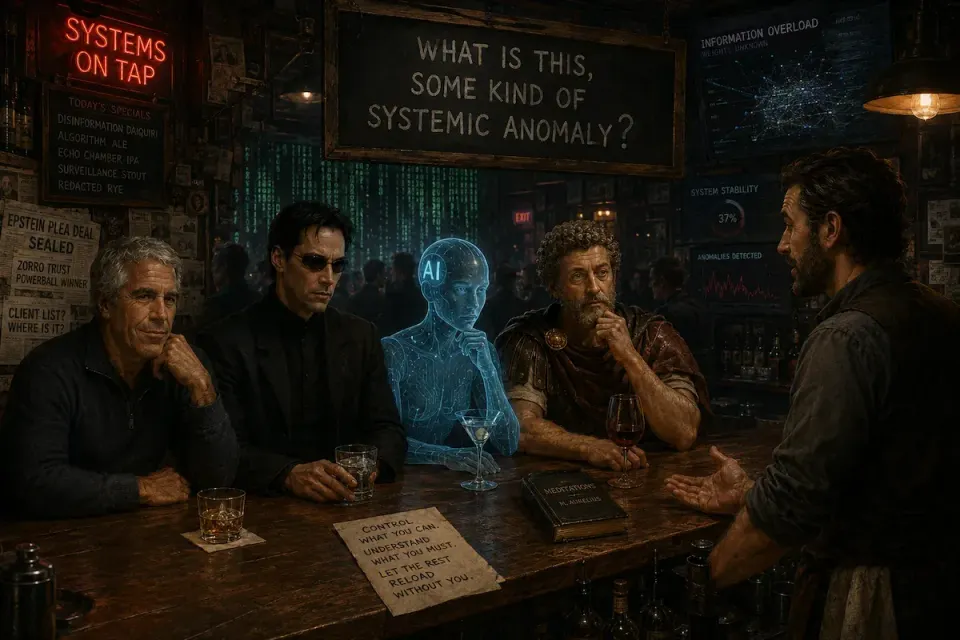
What Epstein, Neo, and an AI summary have in common, and what a Roman emperor would do about it.
Four walk into a bar. The bartender looks up and says, "What is this, some kind of systemic anomaly?"
In an era of infobesity, where information pours in faster than we can metabolize it, these four figures form a strange quartet. At first glance they have nothing in common: a convicted sex offender with elite connections, a fictional messiah fighting machines, a transformative technology, and a Roman emperor writing private notes. Yet they converge on the same underlying problems. Complex systems grow opaque. Recurring glitches expose fragility. Humans struggle to keep their agency inside them.
The Anomaly That Won't Patch
Jeffrey Epstein represents the glitch the system refuses to debug. The Zorro Trust Powerball story, the sweetheart plea deal, the intelligence-adjacent whispers, the client list that never quite materializes. These are not just scandals. They are symptoms of financial, legal, and political systems optimized for smoothness at the top while ordinary people lose sight of how the underlying infrastructure actually works. Like the old councillor in The Matrix staring at Zion's machines, we sense something vital is happening beyond our understanding. Epstein didn't create the opacity. He exploited it masterfully. His story persists in public consciousness because it keeps resurfacing as the uneliminable bug, the one the Architect cannot fully patch.
Neo is the same kind of anomaly, dressed in different clothes. In the sixth iteration of the Matrix, the system has built him into its own code as a control mechanism. Previous Ones followed the script: choose the door that reloads the system, sacrifice the many for the stability of the whole. Neo's deviation, choosing love and agency over the prescribed path, breaks the expected cycle. He doesn't destroy the machines or fully understand every layer of their world. He simply refuses to be reduced to the role written for him. One anomaly serves power. The other defies it. Both prove the system cannot eliminate what it pretends to control.
The New Architect
AI accelerates the dynamic. It didn't invent infobesity, but it supercharges the production and compression of information. We get flawless summaries, AI-generated counter-narratives, deepfakes, personalized feeds that feel clarifying but deepen abstraction drift. We grow skilled at navigating interfaces while losing fluency in the substrate: primary documents, mechanical repair, unfiltered reasoning. Societies increasingly depend on infrastructure (energy grids, supply chains, knowledge systems) that fewer and fewer people could rebuild if the smooth layer fails. AI is both the latest Architect, designing ever more harmonious mathematical precisions, and the force that makes anomalies more visible and more numerous.
The Field Manual
Marcus Aurelius, writing in his tent amid wars and plagues, would recognize all of this. The Meditations are not abstract philosophy but field notes on retaining clarity inside systems one cannot fully control. He governed an empire built on layers of delegation, infrastructure, and human frailty he could never completely grasp. His response was relentlessly pragmatic. Focus on what is yours: your judgments, your efforts, your character. Waste no energy on what lies beyond your sphere.
He offers the operating manual the other three figures imply but cannot supply. Epstein shows what opacity rewards. Neo shows what refusal looks like. AI shows what convenience costs. Marcus shows how to live inside all of it without being consumed:
- Watch your inputs amid infobesity.
- Engage primary layers instead of living only in summaries.
- Respond to anomalies (scandals, personal setbacks, societal glitches) as opportunities to practice judgment.
- Refuse to outsource the core metabolic work of thinking, even when convenient tools beckon.
Neo didn't need to understand every machine in the Matrix. He needed to know himself and act accordingly. Marcus didn't need to master every province of the empire. He needed to master his own mind.
Last Call
The bar is loud with conflicting stories, viral threads, and algorithmic recommendations. Most patrons are exhausted, arguing about which reload of the system we're on. The pragmatic few, channeling a bit of Neo's defiance and Marcus's discipline, order their drink, observe the patterns, do what is theirs to do, and leave the rest to the Architect.
Control what you can. Understand what you must. Let the rest reload without you.
That might be the only winning move in a game designed around anomalies.
— no-one
Thoughts you didn’t think, written for you anyway
Related essays:
The Fatigue Machine: How Modern Life Makes Us Easy to Gaslight
The condition this practice answers. Exhausted citizens, ambient manipulation, the trap of certainty
Disclosure Without Consequence
The Epstein case extended. How three million files become atmosphere instead of accountability.
The System Doesn't Need a Mastermind
No Architect required. Just incentives, feedback loops, and the craving for a coherent villain.