The Perimeter
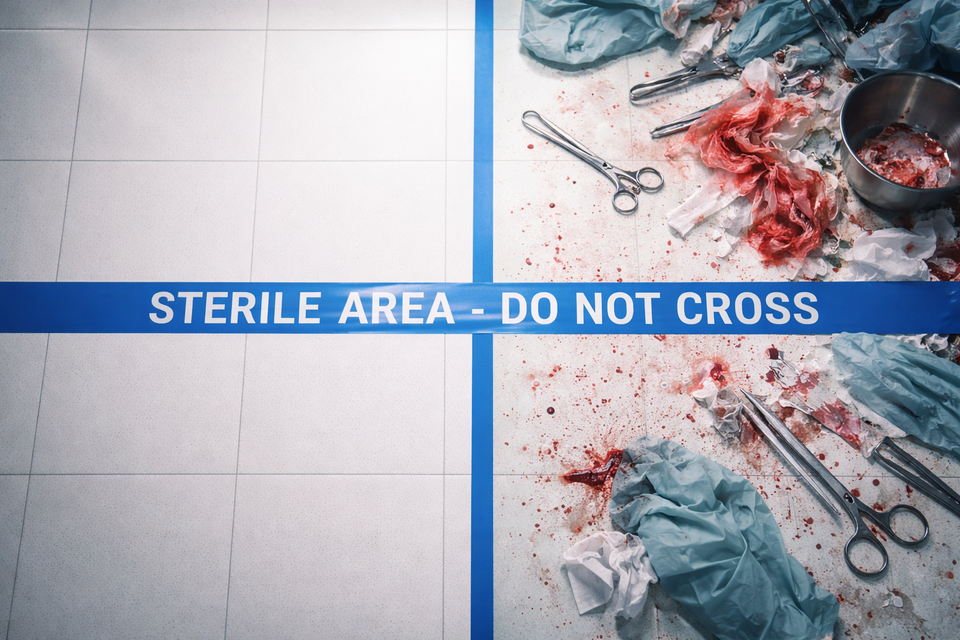
When federal agents are executing an operation, serving warrants, making arrests, whatever it is, there's a perimeter. A secured area. A zone where the mission is happening. Everyone inside that zone is operating under a different set of rules than the rest of the city. Officers are armed, stressed, running on adrenaline, and making split-second decisions about who is a threat and who isn't.
And for some reason nobody wants to ask the most basic question:
Why are civilians inside that perimeter in the first place?
Here's what happens inside a secured perimeter. This isn't theory. Only decades of tactical doctrine, stress physiology, and operational reality.
An officer in a live operation is not calm. Adrenaline is pumping. Cortisol is flooding. The thinking part of the brain, the part that weighs options, considers context, gives people the benefit of the doubt, gets pushed aside. Older systems take over. Survival systems. Fight or flight. Binary thinking. Safe or unsafe. Threat or non-threat.
Now drop a civilian into that environment. An unknown person moving toward agents. Possibly holding something. Possibly armed. No way to know. No time to run a background check.
Permits don't announce themselves. Neither does parenthood, skin color, gender, careers or good intentions. What registers is movement, proximity, and posture. That's all an officer under stress can process.
So when someone crosses into a perimeter, for any reason, with any intention, they become a variable. Another body to track. One more potential threat consuming bandwidth meant for decisions that might end a life.
Every additional body compounds the problem. Movement increases. Surroundings get louder. Confusion spreads. Decision windows compress. Margins for error shrink. Everything gets faster, coarser and more dangerous for everyone.
Every single time one of these incidents happens, Minneapolis or wherever, the conversation starts in the same place. Someone is hurt or killed. Questions begin. Was the shooting justified? Was the force proportional? Did the victim pose a real threat?
Valid questions. Each worth investigating.
But notice the conversation always starts only when civilians are already inside the perimeter. Presence is treated as background. Neutral. Unremarkable. Like weather.
Nobody backs up one step and asks:
Why are civilians inside that perimeter in the first place?
Take that question seriously and suddenly responsibility spreads out. To protesters who entered. To politicians who encouraged it. To the entire framework that rebranded a live federal operation as a protest venue.
The left doesn't want it because their narrative requires pure victims. Innocent bystanders gunned down by jackbooted thugs. Acknowledge that entering a secured perimeter during a live operation is itself a dangerous act, regardless of intention, and you've complicated the story. Distributed the blame. Undermined the political utility of the death.
The right gets closer. They'll point at mayors who told police to stand down, governors who refused cooperation, local authorities who deliberately created chaos. All worth investigating. But they stop there. Use it as ammunition against political opponents instead of following it further. If you knew local authorities would refuse to secure the perimeter, why wasn't the operational plan adjusted? If non-cooperation was predictable, why were agents put in conditions guaranteed to produce bad outcomes? That question points at federal planning and command decisions, and the right doesn't want to go there.
So both sides skip the question. Start the clock at the moment of confrontation. Get exactly what they need: a clean story with a clear villain.
Meanwhile, the pattern repeats. Civilians enter perimeters. Someone gets killed. Outrage erupts. Political warfare ensues. Nothing changes. Next incident.
If you walked into an operating room during open heart surgery, no scrubs, no authorization, because you wanted to watch, document or help, and the surgeon flinched and nicked an artery, would we spend the next two weeks debating whether the surgeon was competent?
Maybe. But the first question would be:
Why are you inside the operating room in the first place?
Perimeters exist for the same reason sterile fields exist. Not because everyone inside is perfect or because agents never make mistakes. Margins are too thin. Variables must be controlled. One unexpected body in the wrong place at the wrong time can turn a controlled situation into a catastrophe.
That's not a political statement. That's physics.
Some of the people entering these perimeters aren't naive. They know it's dangerous. In some cases they've been there before, had physical confrontations with agents. They return anyway. Armed, in some cases.
Why?
Because the political incentive structure rewards it. Politicians call presence courage. Media rebrands documentation as resistance. Social media celebrates confrontation as heroism. Nobody in that ecosystem tells people to stay outside the perimeter. That their life is worth more than a viral video. Or that physics does not care about their politics.
Instead, the message is:
Show up. Get close. Bear witness. Stand your ground.
And when someone dies doing exactly what they were encouraged to do, the same people who encouraged it convert the death into ammunition. Fundraising. Mobilization. Political leverage.
The person who encouraged presence faces no consequences. The person who followed the encouragement is dead. And the cycle resets.
The question that should define every one of these incidents is not who pulled the trigger.
It's who told civilians the perimeter was a place they should be.
Follow that question far enough and you'll stop blaming agents or victims. You'll start looking at the people who created the conditions and walked away clean.
That's why nobody wants to have this conversation. And exactly why it's the only one that matters.