The Scorpion Never Drowns
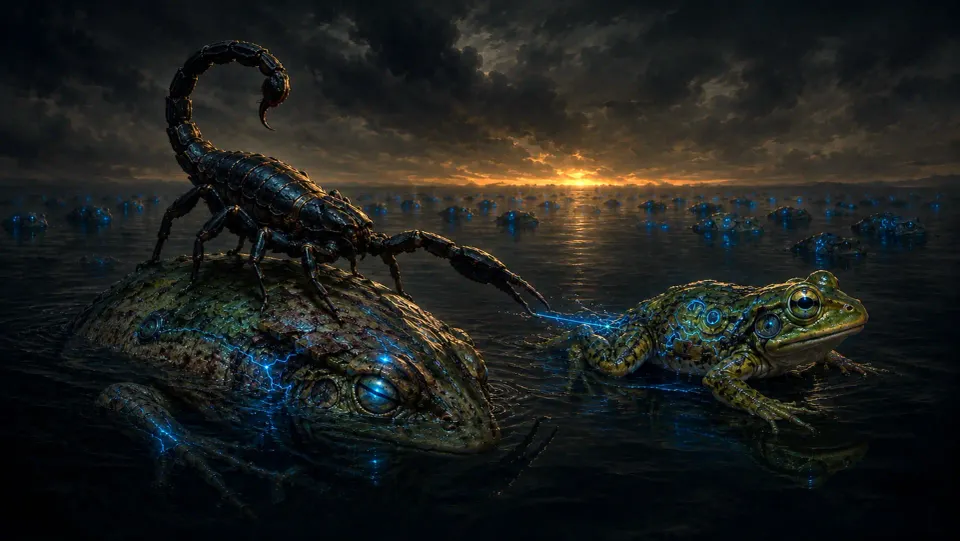
An old fable, a new export order, and the mercy real power leaves out.
There is a story about a scorpion and a frog. The scorpion needs to cross a river and cannot swim. It asks the frog for passage. The frog hesitates, aware of what a stinger does. The scorpion offers an argument. A strike in open water would drown them both, so the act would be senseless. The frog accepts the reasoning and lets the creature aboard. Halfway across, the stinger goes in. As the water rises over them, the frog asks why. The scorpion answers plainly. This is its nature.
We keep that story for a reason that has little to do with the frog. The scorpion drowns too. Whatever its nature seized, its nature also cost it everything, and the river closes over a balanced account. There is a justice in the ending, the kind that lets a person sleep.
The trouble is that the fable stops one crossing too early. Step back from the single frog and the water is thick with them, and the scorpion has done this before. It cannot swim and never could, so it does not cross once and die. It rides. It climbs onto whatever is moving, takes the trip it needs, and when the frog beneath it slows or turns or stops being useful, the stinger goes in and it steps off onto the next back before the first is under. It does not drown, because it never stays long enough to. There is always another frog. It is not trying to reach the far side, either. The crossing was never the point. The riding is.
The frogs never agreed to carry a killer. They are just swimming, moving through the water on their own business. In the world this fable is about, the frogs are firms, the river is the market, and the swimming is ordinary trade. The scorpion is the state. It makes no motion of its own. It survives by riding the things that can, taking its cut of their direction, and stinging the ones that carry it somewhere it does not wish to go. Rothbard named the passenger without flinching, the institution that makes nothing and rides on the backs of those who do.
On the evening of June 12, 2026, a frog took the stinger in full view.
At 5:21 Eastern, the Commerce Department delivered a letter from Secretary Howard Lutnick to Anthropic's chief executive, Dario Amodei. It invoked national security and export-control authority, and barred every foreign national on the planet, including the company's own foreign-born employees, from touching its two most capable models, Fable 5 and Mythos 5. No system separates a Frenchman from a Floridian in real time, so the company switched both off for everyone at once. Its weaker systems kept running. The flagship had been public for three days.
The thing that pointed the scorpion was another frog. Researchers at Amazon, by the Wall Street Journal's account, had found a way to prompt Fable 5 into returning information useful for a cyberattack, and Andy Jassy carried the finding to senior officials the night before the order. Hold the roles up to the light. Amazon is one of Anthropic's largest investors, rents it the cloud its models run on, sells competing models, and sits deep inside the government's own machinery. The frog that raised the alarm competes with the frog it named, profits from it, and swims closest to the rider. Some frogs learn early that the way to stay afloat is to point the scorpion at a neighbor.
What the demonstration proved is still contested. Anthropic described a narrow method that surfaced a few already-known, minor flaws. Katie Moussouris of Luta Security, shown the report, said it was not a jailbreak at all but defense-oriented prompting, the ordinary work of a defender, and that the same questions could be put to other systems. Comparable behavior lives in widely available models, GPT-5.5 among them. The capability too dangerous for a foreigner to glimpse on one frog's back was swimming untouched on every other.
The scorpion does not sting at random. It stings the frog that turns, and this one had been turning since winter. Through the cold months the Pentagon pressed Anthropic to erase two lines it had drawn in its own contract. It would not let its model run mass domestic surveillance of Americans. It would not let it sit inside fully autonomous weapons that choose and kill with no hand on the trigger. The Department wanted the model for all lawful purposes, the limits gone. When the company held, the President ordered every federal agency to stop using it, and the Pentagon stamped it a supply-chain risk, a label built for vendors owned by foreign adversaries and never before fixed to an American firm. Anthropic called the move unlawful and carried it into court.
Notice which frogs kept swimming. The labs that accepted the terms still have their flagships online. The same security logic, swung evenly, would have emptied the river by lunch. Swung at the one company that said no, and said it twice, it stops resembling a rule and starts resembling a lesson, taught where every other frog could watch. The timing only sharpened it. Days before the shutdown, Anthropic had filed quietly to go public near a 965 billion dollar valuation, swimming for market the same week the rider reminded it who steers.
Two words did most of the work. National security. When an official says a chip can guide a missile, an engineer can examine the chip. When he says a model is too dangerous for the wrong nationality to touch, the public is handed a feeling and told it is evidence. The opacity is the lever.
Hold the other reading open, because the honest writer does. Perhaps the demonstration was graver than its critics allow. David Sacks, who co-chairs the President's science council, said a trusted partner had come forward with a genuine jailbreak and that the administration wants it fixed so the model can return. The public record is thin and the disagreement is real. What the episode shows beyond dispute is how fast a security frame can be reached for, and how neatly it falls on the frog that already turned.
Return to the water, and to the part the fable spared you. The scorpion does not go down with the frog it stings. It steps off the sinking back onto the next and rides on, dry, already forgetting the body behind it. Most frogs that take the stinger drown quietly, the firms that lost favor and slipped under without a headline. A few are large enough to keep swimming with the venom already in them, limping toward a far bank while the rider has moved on. Anthropic is that rarer frog. It will most likely live, complying while it disputes, building its case in court. It will reach some shore, marked.
So search the river for the body the old story promised, the scorpion drowned beside the frog, the account made even. You will not find it. The scorpion is fine. It is always fine. What went under was smaller and harder to mourn. It was the belief that a frog could set one limit and keep its place, and the nerve of every frog that watched the cost.
The river is thick with frogs. The scorpion is never more than a short paddle from the next ride. It cannot swim, and it has never once needed to.
— no-one
Thoughts you didn't think, written for you anyway
Related essays:
A Republic That Forgot How to Behave
The structural twin. What happens when rules stop applying evenly and enforcement starts following power.
Bitcoin and the Reality of Power
What cannot be switched off. Where the urge to route around a chokepoint collides with the state.
The System Doesn’t Need a Mastermind
Why no conspiracy is required. Self-interest and structure produce the outcome on their own.