The Superman Problem: Why Utopia Needs a Warden
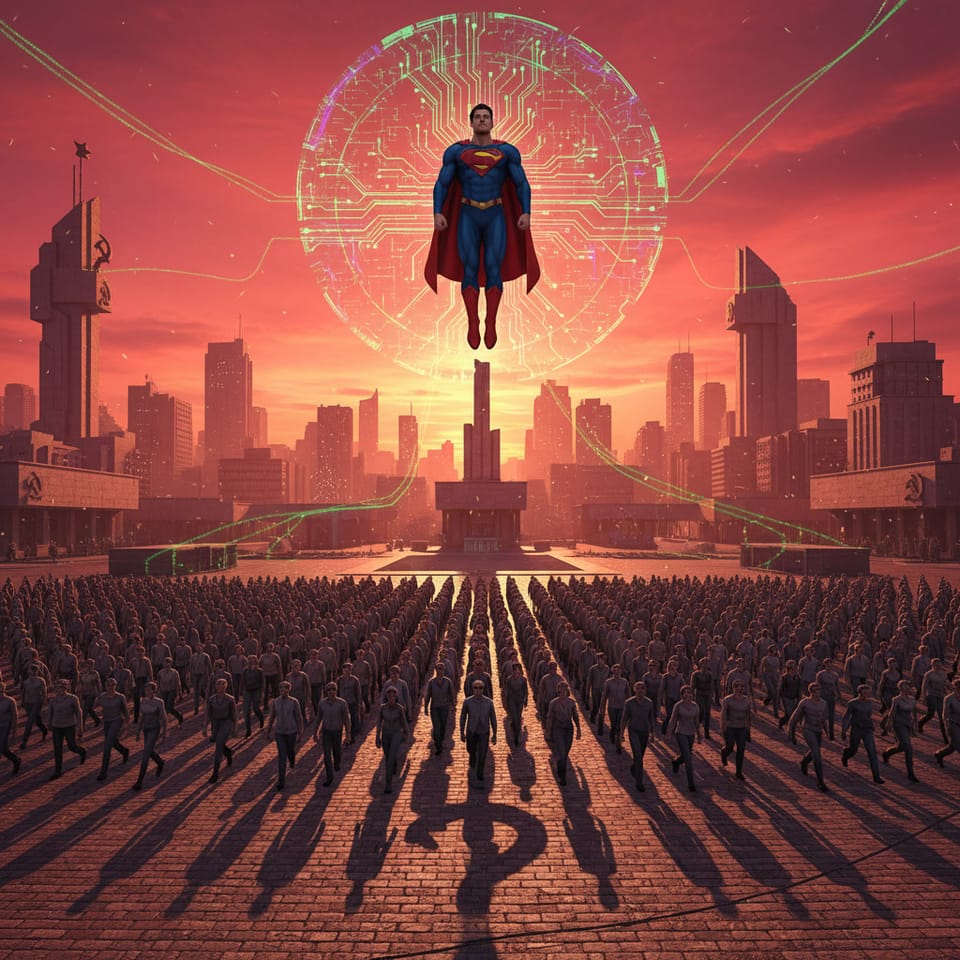
DC's Red Son story line lands harder than most political essays:
even Superman, the most moral being imaginable, can’t make socialism work without control.
He abolishes poverty, ends war, and rebuilds the Soviet Union into paradise.
But soon paradise begins to fray.
People complain. Crime mutates. Individual will resurfaces.
And in that moment of disobedience, the dream cracks.
Superman turns to Brainiac to surveillance, to mind correction, to “necessary” control because utopia at scale requires obedience, and obedience requires enforcement.
It’s a comic-book truth that exposes a human one: no ideal survives its own logistics.
The Small-Scale Miracle
At the level of a family, a village, or a cooperative, socialism works.
Shared labor, shared reward, shared purpose, it’s empathy with structure.
When everyone sees everyone else’s effort, moral pressure replaces market pressure.
You don’t need police or profit; you just need decency.
That’s why communal living experiments, monasteries, and small worker co-ops often thrive.
Their currency is trust, not money.
Their success depends on proximity, on faces, not statistics.
But trust dilutes with distance.
Once a society outgrows familiarity, virtue has to be administered.
The Scale Breaks the Spell
Scale changes everything.
The moment a system expands beyond personal accountability, it replaces empathy with policy.
What once relied on conscience now relies on codes, quotas, and committees.
That’s where Superman stumbles.
He assumes moral perfection can be centralized, that one mind can guarantee fairness for billions.
But even if that mind is incorruptible, the machinery it builds isn’t.
The moment perfection requires data collection, loyalty checks, and “education centers,” utopia has sprouted its first prison.
Every large-scale socialist project met the same fate. Compassion doesn't scale without coercion. Once virtue becomes administrative, the dream begins to police itself.
The Brainiac Bargain
Brainiac, in Red Son, is more than a villain; he’s a metaphor.
He represents the algorithmic conscience, the technocrat’s answer to moral failure.
If people can’t behave, then code will make them.
If citizens won’t cooperate, data will predict them.
That bargain is the heartbeat of every authoritarian utopia:
control traded for comfort, surveillance disguised as care.
And the tragedy is that it works for a while.
Order blooms, crime vanishes, productivity soars.
Then one day, someone notices that the sky feels heavy.
The Universal Flow
Systems don’t break from ideology, but from variance.
Humans want different things and no amount of equality can flatten that impulse.
Capitalism harnesses it through markets; socialism suppresses it through moral pressure.
Both depend on the same hunger: to matter.
Superman’s failure isn’t ideological.
It’s anthropological.
He forgets that meaning comes from freedom, even the freedom to choose poorly.
A world without choice isn’t heaven; it’s an efficient coma.
The Quiet Moral
Utopia sounds like mercy but behaves like management.
It begins with compassion and ends with compliance.
That’s not cynicism, it’s the physics of power.
Maybe the lesson of Red Son isn’t that socialism fails, but that scale corrupts empathy.
The larger the vision, the smaller the individual becomes.
And when the dream starts needing mind control to keep everyone good, the hero has already become the system he tried to save.
— no-one
Thoughts you didn’t think, written for you anyway
Disclaimer
Superman, Batman, Brainiac, Wonder Woman, and all related characters and elements are the property of DC Comics and Warner Bros. Entertainment, divisions of Warner Bros. Discovery.
This work is a non-commercial critical commentary created under fair-use principles for purposes of analysis, reflection, and discussion.
No ownership, endorsement, or affiliation is claimed. All trademarks and copyrights remain the property of their respective owners.